Manufacturing Type Finder
Find Your Manufacturing Fit
Answer these 5 questions to identify which manufacturing type best suits your business needs. Your results will include key characteristics and industry examples.
Manufacturing
Why this fits your business:
When you think of manufacturing, you might picture cars rolling off an assembly line or phones being assembled in a factory. But manufacturing isn’t just one thing. It’s a collection of different systems, each designed for specific kinds of products, volumes, and production needs. Knowing the six primary types of manufacturing helps businesses choose the right approach, cut costs, and avoid costly mistakes. Whether you’re starting a small shop or scaling a factory, understanding these models makes all the difference.
Discrete Manufacturing
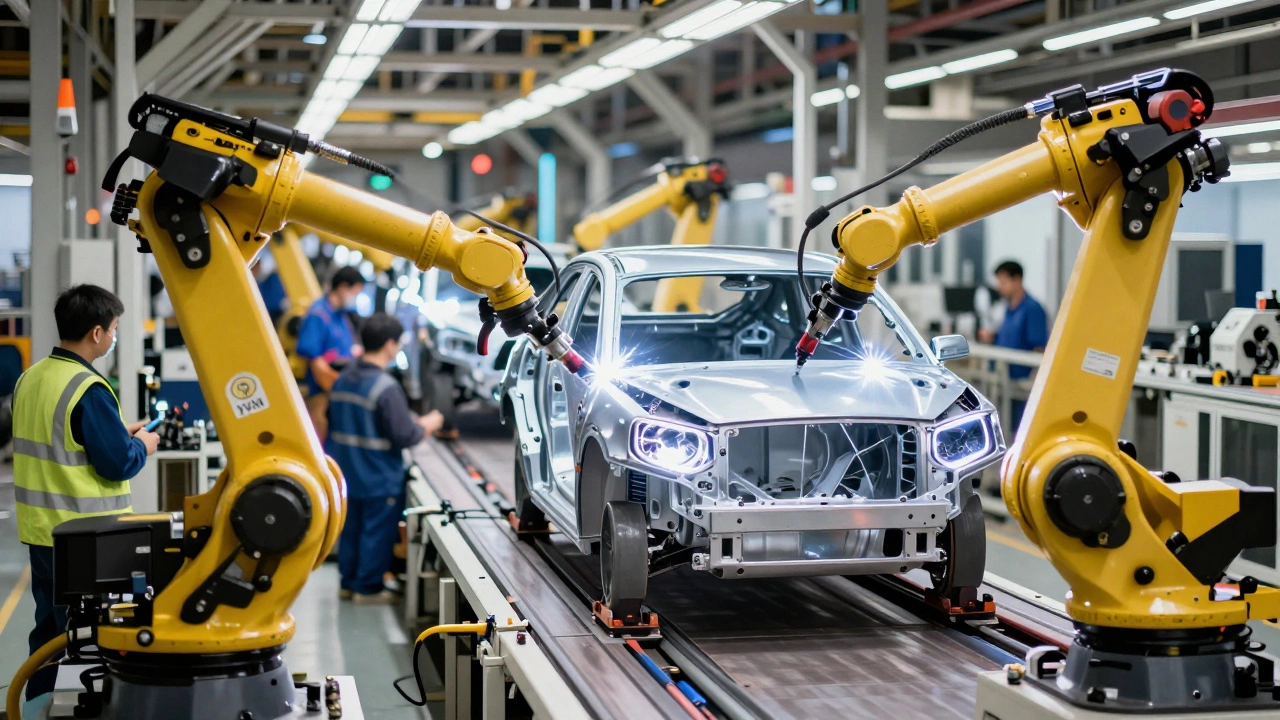
Discrete manufacturing is what most people picture when they think of factories. You make distinct, countable items-like smartphones, bicycles, or washing machines-where each unit can be taken apart and inspected individually. Every product has a unique bill of materials and assembly sequence. This type of manufacturing relies on assembly lines, robotic arms, and precise quality checks at each stage.
Think about a car factory. Each vehicle starts as a chassis, then gets an engine, wheels, seats, and electronics added one by one. You can track each car by its VIN number. That’s discrete manufacturing. It’s common in automotive, electronics, aerospace, and furniture industries. The key advantage? Flexibility. You can customize products without redesigning the whole line. The downside? High setup costs and complex inventory tracking.
Process Manufacturing
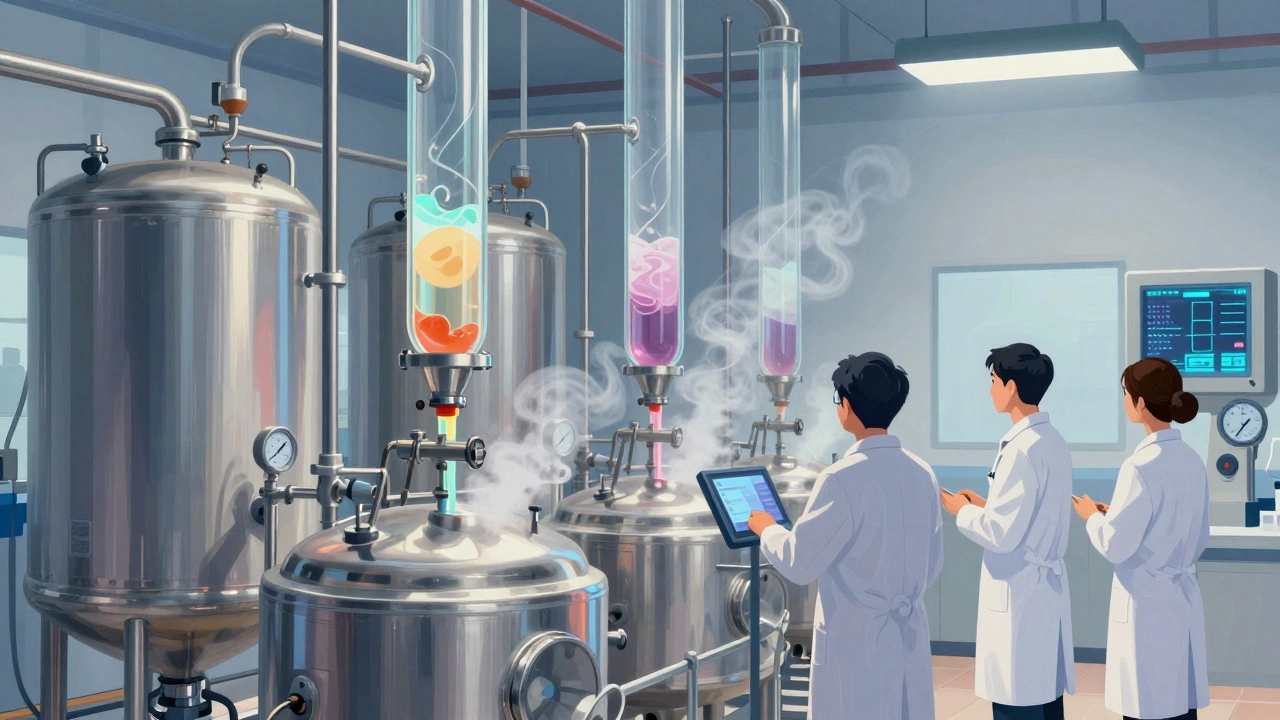
Process manufacturing is the opposite of discrete. Instead of assembling parts, you mix, blend, or transform raw materials into new products. Think of it like baking a cake-you don’t put together individual ingredients after it’s done. You combine them in bulk, and the end product is homogeneous.
This type dominates industries like food and beverage, pharmaceuticals, chemicals, and cosmetics. A soda plant doesn’t build 1,000 bottles one at a time. It runs syrup, water, and CO2 through pipes and fills thousands of bottles continuously. The output is measured in liters, gallons, or kilograms-not units.
Process manufacturing requires strict control over recipes, temperatures, and timing. One wrong setting can ruin an entire batch. That’s why these systems use sophisticated software to track formulas, compliance, and shelf life. If you’re making medicine, a single error could be dangerous. Accuracy isn’t optional here.
Batch Manufacturing
Batch manufacturing sits between discrete and process. You produce products in groups-batches-rather than one at a time or continuously. Each batch goes through the same steps, but you stop between batches to clean, reconfigure, or switch materials.
This is common in industries where demand fluctuates or products need customization. Think of a bakery making 50 chocolate cakes one day, then switching to 100 vanilla cupcakes the next. Or a paint factory mixing 200 gallons of blue paint, then cleaning the tanks before making red. You get the efficiency of volume production without the rigidity of continuous lines.
Batch manufacturing is popular in pharmaceuticals, specialty chemicals, and artisanal foods. It’s ideal when you need to meet regulatory standards for each batch (like FDA documentation) or when customer orders vary. The trade-off? Downtime between batches. Cleaning, setup, and changeovers eat into productivity. But for many small to mid-sized manufacturers, it’s the sweet spot.
Job Shop Manufacturing
If you need one custom item made-like a one-off machine part, a prototype, or a tailored metal bracket-you’re looking at job shop manufacturing. This is the most flexible, least automated type. Work moves from station to station based on what each job requires.
Imagine a machine shop with three CNC machines, a welding station, and a grinding bench. One day, a customer needs 5 custom brackets. The next day, someone else needs 10 gear housings. Each job has its own blueprint, tools, and sequence. Workers juggle multiple orders at once, prioritizing based on deadlines and complexity.
Job shops thrive in aerospace, defense, industrial repair, and custom machinery. They serve niche markets where volume doesn’t matter-quality and precision do. The challenge? Scheduling is a nightmare. One delay cascades. But the upside? You can make almost anything without investing in dedicated production lines. It’s the go-to for small businesses and contractors who need to be agile.
Continuous Manufacturing
Continuous manufacturing runs 24/7, nonstop. There are no batches, no stops, no changeovers. Raw materials flow in one end, and finished goods come out the other-constantly. This model is only practical when demand is steady and predictable.
Oil refineries, steel mills, paper plants, and cement factories rely on this. In a refinery, crude oil enters a complex network of distillation towers and chemical reactors. It flows for weeks without stopping. Shutting down costs millions. That’s why these systems are built with extreme redundancy and safety controls.
Continuous manufacturing demands high capital investment, specialized equipment, and skilled operators. But the payoff? Lowest cost per unit. If you’re producing something like gasoline, electricity, or plastic pellets, this is the only way to compete. It’s not for startups. It’s for giants with long-term contracts and massive infrastructure.
Repetitive Manufacturing
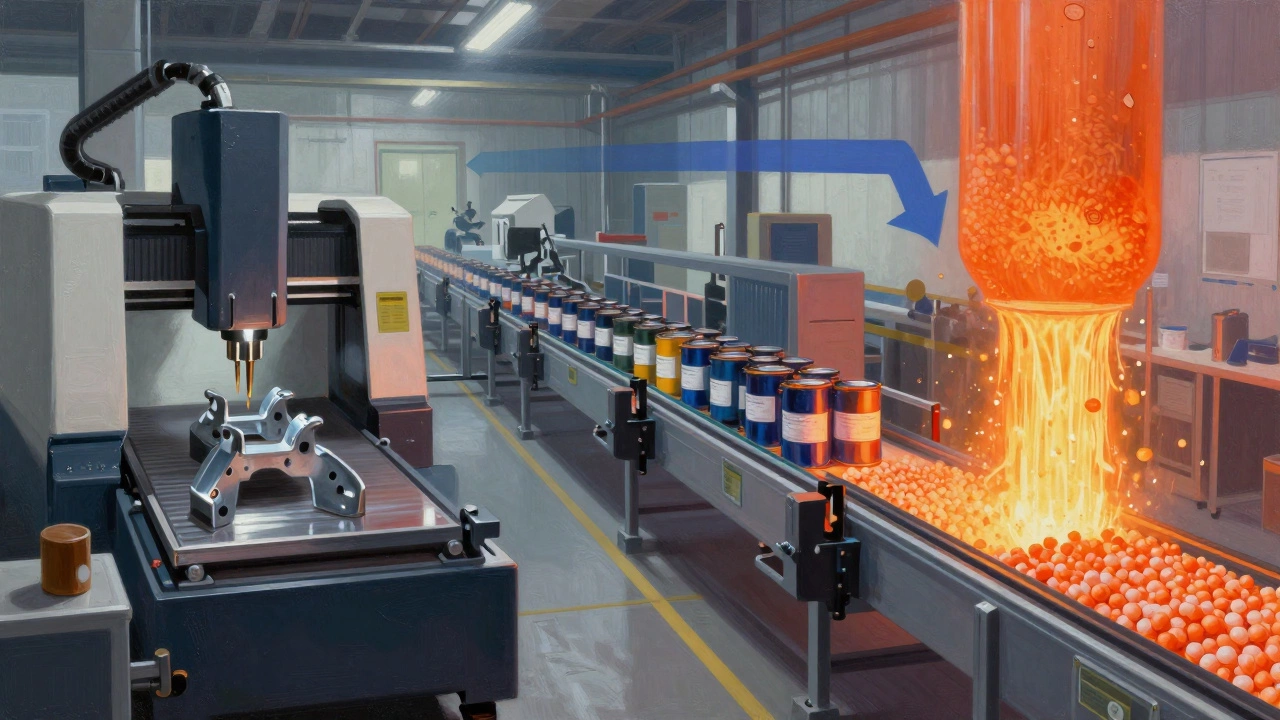
Repetitive manufacturing is like continuous, but slower. You produce the same product-or a small family of similar products-on a dedicated line, day after day. Think of a bottling plant making only one type of water bottle, or a factory cranking out 5,000 identical circuit boards every shift.
This model sits between batch and continuous. You don’t need to clean and retool between runs, but you also don’t run nonstop. Production runs for hours or days, then pauses for maintenance or material restocking. It’s common in consumer electronics, automotive parts, and packaging.
Repetitive manufacturing uses just-in-time inventory and automated quality sensors. If a screw is missing on a circuit board, the system flags it instantly. This type is efficient, predictable, and scalable. But it’s fragile. If demand drops, you’re stuck with idle equipment. If a supplier delays a component, the whole line halts.
Many manufacturers use a mix of these types. A company might use repetitive manufacturing for its best-selling product, batch for seasonal items, and job shop for custom client requests. The smart ones don’t force one model onto everything. They match the method to the product, volume, and customer need.
Why It Matters
Picking the wrong manufacturing type can sink a business. If you try to use discrete manufacturing for shampoo, you’ll waste time and money. If you try to use job shop for mass-producing phone cases, you’ll never meet demand. The right model affects your costs, lead times, quality, and scalability.
Government schemes often support manufacturers transitioning to more efficient systems. Incentives exist for automation, energy efficiency, and adopting lean practices-whether you’re switching from batch to repetitive or upgrading your process controls. Knowing which type you’re in helps you qualify for the right programs.
There’s no single ‘best’ type. The best type is the one that fits your product, your market, and your resources. Start by asking: Are you making one-of-a-kind items? Bulk liquids? Standardized units? Custom parts in small numbers? The answer will tell you where you belong.
What’s the difference between batch and continuous manufacturing?
Batch manufacturing produces goods in groups, with stops between batches for cleaning or changeovers. Continuous manufacturing runs nonstop, with raw materials flowing in and finished products coming out without interruption. Batch is flexible but slower; continuous is efficient but inflexible.
Which manufacturing type is best for small businesses?
Job shop and batch manufacturing are usually the best for small businesses. They require lower upfront investment, allow customization, and can adapt to changing orders. Continuous or repetitive manufacturing needs high capital and steady demand, which most small operations can’t support.
Can a company use more than one manufacturing type?
Yes, most successful manufacturers use a mix. For example, a food company might use continuous manufacturing for its main product line, batch for limited-edition flavors, and job shop for custom orders from restaurants. Flexibility in production models is a competitive advantage.
How does process manufacturing differ from discrete manufacturing?
Process manufacturing transforms raw materials into a final product through chemical or physical changes, like mixing or heating. The output is measured by weight or volume. Discrete manufacturing assembles distinct parts into countable units, like cars or phones. One is about blending; the other is about building.
What industries rely on repetitive manufacturing?
Repetitive manufacturing is common in consumer electronics (like chargers or headphones), automotive parts (such as door handles or sensors), bottled beverages, and packaging. These are high-volume, standardized products with consistent demand.