
IP Strategy Estimator for Small Manufacturers
Answer a few questions about your invention or process to get a tailored recommendation for protecting and licensing your idea without relying solely on expensive patents.
This determines the primary legal framework (Patent vs. Trade Secret vs. Copyright).
Patents are costly for short-lived trends; Trade Secrets work better for long-term processes.
If easy to copy, Trade Secrets are risky. If hard, they are powerful.
Select options and click "Get Recommendation" to see your customized IP strategy.
You’ve got a brilliant concept for a new kitchen gadget or a more efficient assembly line process. You know it works because you’ve built a prototype in your garage. But when you look up the cost of filing a patent, your heart sinks. We’re talking thousands of pounds just to get started, plus years of waiting for approval. So, what do you do? Do you keep it under wraps forever, or do you risk showing it to potential partners and getting copied?
Here’s the good news: you don’t need a granted patent to license your idea. In fact, many small-scale manufacturers operate successfully using alternative legal frameworks that are faster, cheaper, and often more effective for niche products. The key is understanding how intellectual property works beyond the patent office. It’s about controlling information, building relationships, and structuring deals that protect your upside even if someone else tries to steal your thunder.
The Reality Check: Why Patents Aren’t Always the Answer
Patents are powerful, but they are blunt instruments. They require public disclosure. To get a patent, you must explain exactly how your invention works to the world. If your competitor reads your patent and decides to tweak one minor component to bypass your claims, you might lose out. Plus, patents expire. For fast-moving consumer goods, a 20-year monopoly is irrelevant if the trend dies in two years.
For small scale manufacturing, speed to market is often more valuable than long-term exclusivity. If you can launch, build brand loyalty, and establish distribution channels before competitors catch on, you win. Licensing an unpatented idea allows you to move at this pace. You aren’t selling a government-granted right; you’re selling access to your expertise, your design files, and your market insight.
Your First Line of Defense: Non-Disclosure Agreements (NDAs)
If you don’t have a patent, your confidentiality is everything. This is where the Non-Disclosure Agreement (NDA), also known as a Confidentiality Agreement, becomes your primary shield. An NDA is a legally binding contract that prevents another party from sharing your proprietary information with third parties or using it for their own benefit without permission.
But here is the trap many inventors fall into: NDAs are only as strong as your ability to enforce them. If a large manufacturer breaches your NDA, suing them can cost more than your entire business is worth. Therefore, use NDAs strategically. Don’t ask every person you meet to sign one. That looks amateurish and scares off casual collaborators. Save the formal NDA for when you are ready to share detailed technical drawings, CAD files, or specific material formulations with a serious potential licensee.
| Strategy | Cost | Duration | Best For |
|---|---|---|---|
| Utility Patent | High (£5k-£15k+) | 20 Years | Complex mechanical inventions |
| Trade Secret | Low (Legal admin only) | Indefinite | Recipes, processes, algorithms |
| Copyright | Very Low | Life + 70 Years | Designs, manuals, software code |
| Trademark | Medium (£170+ per class) | Renewable | Brand names, logos, slogans |
Leveraging Trade Secrets Instead of Patents
A Trade Secret is information that has commercial value because it is not generally known and is subject to reasonable efforts to maintain its secrecy. Unlike patents, trade secrets never expire as long as you keep them secret. Think of Coca-Cola’s formula. They didn’t patent it; they hid it. If they had patented it, anyone could have read the formula after 20 years and replicated it perfectly.
In small scale manufacturing, trade secrets often work better than patents for things like:
- Manufacturing Processes: How you mix materials, temperature settings, or assembly sequences that make your product durable or cheap to produce.
- Customer Lists: Who buys from you and why. This data is hard to replicate quickly.
- Source Codes: If your product involves embedded software, the code itself can be a trade secret.
To license a trade secret, you structure the deal so the licensee pays for access to the "know-how." You provide them with the necessary documentation to manufacture the product, but you retain ownership of the underlying methodology. If they stop paying royalties, you revoke their access to the updated manuals and support, effectively slowing down their production efficiency.
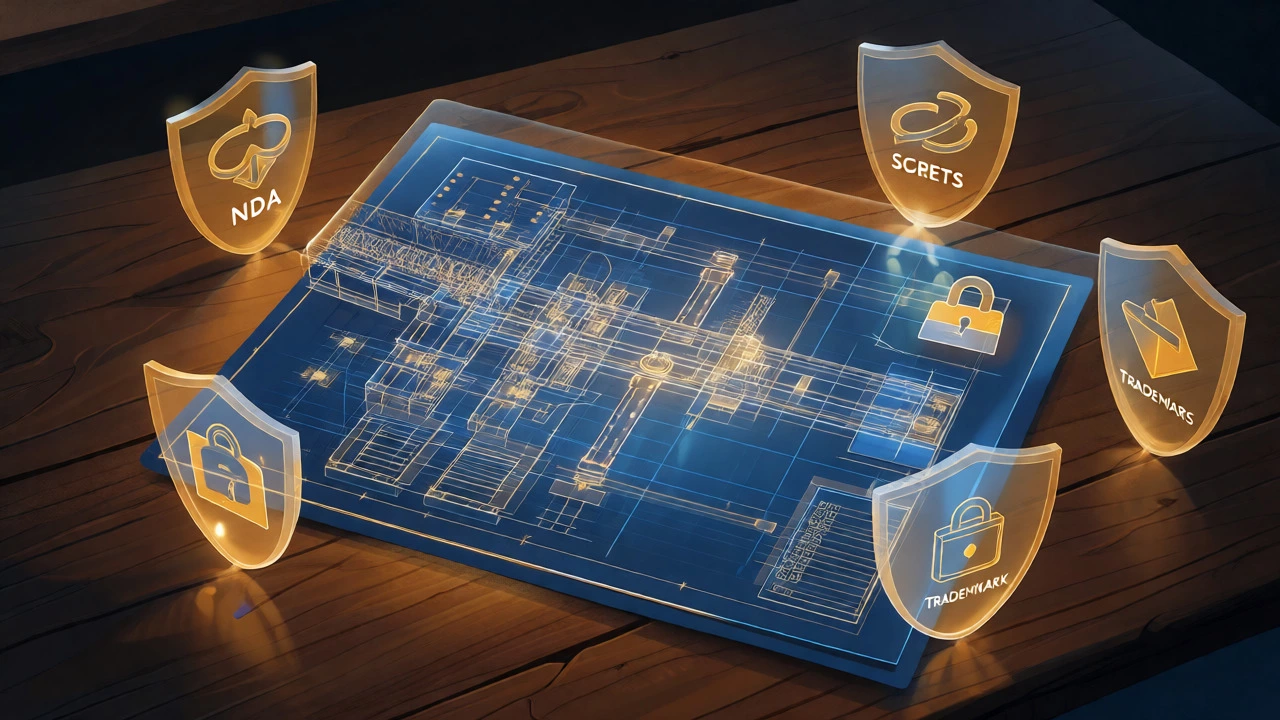
Copyright and Trademarks: The Overlooked Assets
Many people confuse copyright with patents. Copyright protects the expression of an idea, not the idea itself. You cannot copyright a "new type of chair," but you can copyright the specific artistic pattern on the upholstery, the user manual, and the unique shape if it has artistic merit. More importantly, copyright is automatic. You don’t need to register it in the UK to have basic rights, though registration helps in court.
Trademarks are even more critical for licensing. A Trademark protects your brand identity-the name, logo, or slogan associated with your product. When you license an idea, you are often licensing the brand trust as much as the technology. If you create a successful line of ergonomic tools, the value lies in customers recognizing your logo. Even if a competitor copies the tool’s function, they cannot copy your trademarked brand name without facing legal action.
This creates a "moat" around your business. Competitors can make similar products, but they can’t call them by your name or use your distinctive packaging. This brand equity is highly licensable. Companies pay huge sums to attach their reputation to your product, and vice versa.
Structuring the Deal: Royalties vs. Lump Sums
Once you’ve protected your assets via NDAs, trade secrets, and trademarks, you need to decide how to monetize the license. There are two main models:
- Royalty-Based Licensing: The licensee pays you a percentage of net sales (typically 3% to 7% for physical products) or a fixed amount per unit sold. This aligns your incentives with theirs. If they sell more, you earn more. However, it requires auditing. You need contractual rights to inspect their books to ensure they aren’t underreporting sales.
- Lump Sum Payment: The licensee pays you a one-time fee upfront. This is great for cash flow, especially if you are bootstrapping your next project. But you miss out on the upside if the product becomes a massive hit. Use this option if you are unsure about the product’s longevity or if the licensee is taking significant financial risk.
Hybrid models exist too. You might take a smaller upfront fee to cover your prototyping costs, plus a lower royalty rate. This reduces the barrier for the licensee to say "yes" while keeping you invested in the product’s success.

Finding Partners Without Burning Bridges
Who licenses unpatented ideas? Big corporations often want patents because they have legal teams to fight infringement battles. Small and medium-sized enterprises (SMEs), however, are often more agile. They lack the R&D budget to develop new concepts from scratch. They are hungry for ready-to-manufacture designs.
Look for manufacturers who already produce similar items but lack innovation. If you have a better design for a plastic storage bin, approach companies that currently make boring, generic bins. They have the machinery and the distribution network; they just need your design edge. Pitch them on the "turnkey" aspect: "Here are the CAD files, the material specs, and the marketing angle. You start producing next month."
Common Pitfalls to Avoid
Don’t rely solely on verbal agreements. In the UK, contracts for the transfer of IP rights should be in writing to be fully enforceable. Always specify who owns improvements made during the licensing period. If the licensee tweaks your design to make it easier to mold, who owns that tweak? Usually, the licensor wants to own all derivatives, but the licensee will argue they should own improvements they paid for.
Also, beware of "joint development" traps. If you work closely with a factory engineer to refine your prototype, they might claim co-inventorship. Keep clear records of who contributed what. If they just provided standard machining services, they haven’t invented anything. If they solved a fundamental engineering problem, you might need to negotiate a small equity stake or buyout.
Can I license an idea if I haven't filed a provisional patent?
Yes, absolutely. Many deals happen before any patent application is filed. You rely on NDAs and trade secret protections during the initial negotiation phase. Once a deal is signed, you can choose to file a provisional patent to secure a priority date, but it is not a prerequisite for starting conversations.
What happens if my licensee copies my product and cuts me out?
This is the biggest risk. To mitigate it, ensure your contract includes termination clauses for breach. Also, try to hold onto the "keys"-such as exclusive molds, specific supplier relationships, or proprietary software keys-that are difficult for them to replace instantly. Brand recognition is also a defense; if they drop your brand, they lose customer trust.
Do I need a lawyer to draft a licensing agreement?
While templates exist online, hiring an IP attorney is highly recommended for the final contract. Intellectual property law is nuanced, and a poorly drafted clause regarding "territory" or "exclusivity" can cost you millions later. Look for lawyers who specialize in SME transactions rather than just big corporate IP litigation.
How do I prove my idea existed before the licensee saw it?
Keep dated digital records. Email yourself the design files with timestamps. Use cloud storage with version history. In the UK, you can also deposit documents with a solicitor or use a trusted third-party service that time-stamps documents. This creates an audit trail proving prior art and ownership.
Is it better to license or manufacture myself?
Licensing is lower risk and capital-intensive. You avoid inventory costs and shipping logistics. Manufacturing gives you higher margins and total control but requires significant working capital and operational expertise. For small scale manufacturers, licensing often allows you to diversify income streams without overextending your resources.