Manufacturing Location Cost & Risk Estimator
How to use: Select a target country, input your base unit price and monthly volume. The tool calculates estimated shipping, duties, and overall risk profile based on 2026 industry averages.
China 🇨🇳
USA 🇺🇸
India 🇮🇳
Vietnam 🇻🇳
Mexico 🇲🇽
$
Affects duty rates and logistics complexity.
Estimated Results
China
Total Landed Cost / Unit
$0.00
Monthly Production Value
$0
Risk Assessment
Low
Cost Breakdown
Strategic Insights
There is no single "best" manufacturing country on Earth. If you prioritize cost, China remains the undisputed king. But if you care about speed, proximity to markets, or geopolitical safety, the answer shifts dramatically toward the United States or India. The landscape of global production has changed so much in the last five years that relying on a single location is now a massive business risk.
This guide breaks down where you should actually be looking in 2026. We are moving past the era of "cheapest labor wins." Today, it is about resilience, automation, and government incentives. Whether you are a startup founder sourcing your first batch of products or a C-suite executive optimizing a multi-billion dollar supply chain, understanding these dynamics is critical for your bottom line.
Key Takeaways
- China still leads in scale and component availability, but faces higher costs and geopolitical friction.
- The United States is winning back high-value manufacturing through automation and subsidies like the CHIPS Act.
- India is emerging as the top alternative for consumer goods, driven by strong government schemes and demographic dividends.
- Vietnam and Mexico are rising as strategic "near-shoring" hubs for specific industries.
- The "best" country depends entirely on your product type, margin structure, and risk tolerance.
Why the Definition of "Best" Has Changed
Ten years ago, the question was simple: Who can make this widget for the lowest price? That metric is now secondary. In 2026, supply chain leaders look at a different set of criteria. We talk about "resilience" more than we ever have before. A disruption in one region shouldn't halt your entire business. This means diversification is key.
Consider the impact of shipping lanes and trade tariffs. When tensions rise between major powers, duties can spike overnight. A product that made sense to manufacture in one country in 2023 might become unprofitable in 2026 due to a 25% tariff increase. Therefore, the "best" country is the one that offers the best balance of total landed cost (including freight, duties, and insurance) and operational stability.
China: The Giant That Still Dominates
Let’s not pretend China isn’t still the center of gravity for global manufacturing. It produces roughly 30% of the world's industrial output. Why? Because of its ecosystem. If you need a specific type of plastic molding, a custom circuit board, and a packaging supplier, you can find all three within a 50-mile radius in places like Shenzhen or Dongguan. This cluster effect is hard to replicate anywhere else.
However, the days of ultra-cheap labor are fading. Wages in coastal Chinese cities have risen significantly. To stay competitive, factories there are heavily investing in robotics and AI-driven quality control. This makes China excellent for complex electronics and high-volume consumer goods. But for simple textiles or basic assembly, the cost advantage has eroded. You are paying for infrastructure and efficiency, not just cheap hands.
| Country | Strengths | Weaknesses | Ideal For |
|---|---|---|---|
| China | Huge scale, complete supply chain, advanced tech | Rising labor costs, geopolitical risk, long lead times | Electronics, complex machinery, high-volume goods |
| United States | Proximity to market, strong IP protection, automation | High labor costs, regulatory complexity | Aerospace, pharma, high-end automotive, defense |
| India | Low cost, large domestic market, government support | Logistics bottlenecks, inconsistent power supply | Textiles, pharmaceuticals, auto components |
| Vietnam | Low cost, favorable trade agreements, young workforce | Smaller scale, less developed infrastructure | Footwear, apparel, basic electronics assembly |
The United States: Reshoring with Muscle
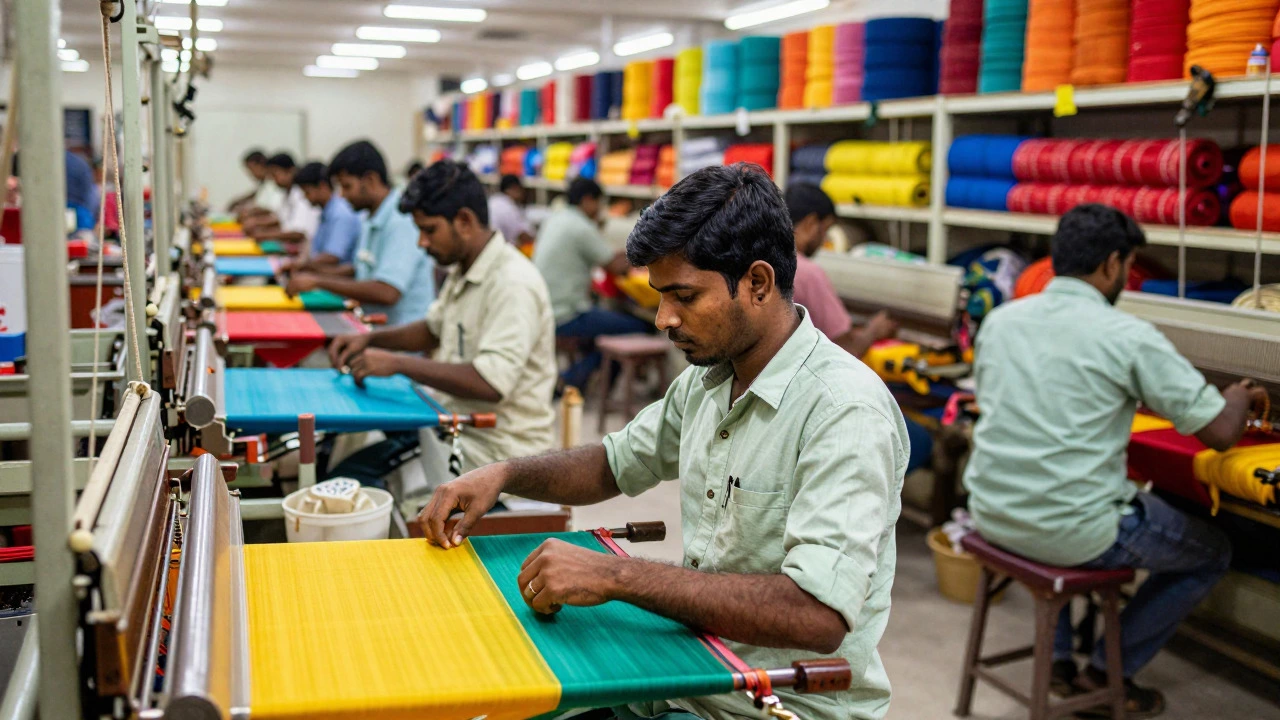
For decades, American manufacturers left for Asia. Now, they are coming home. Why? Because shipping a container from Asia to the US West Coast takes 18-22 days. Shipping from Texas to New York takes two days. That inventory sitting in a warehouse or on a boat is capital you can’t use elsewhere.
The US government has poured billions into bringing jobs back. The CHIPS and Science Act provided over $50 billion in incentives for semiconductor fabrication. Companies like TSMC and Intel are building massive fabs in Arizona and Ohio. This isn't just about politics; it’s about physics and economics. High-value, low-weight items like microchips benefit immensely from being close to their end-users. If you are in the tech or aerospace sector, the US is arguably the best place to manufacture right now due to the talent pool and R&D integration.
India: The Rising Challenger
You cannot discuss the future of manufacturing without talking about India. With a median age of under 29, India has a massive demographic dividend. More importantly, the government is actively pushing the "Make in India" initiative. This includes tax holidays, easier land acquisition laws, and direct subsidies for setting up plants.
India is particularly strong in pharmaceuticals (producing nearly 50% of the world's generic drugs) and textiles. The automotive sector is also booming, with companies like Tata Motors and Maruti Suzuki leading local production. However, logistics remain a headache. Moving goods across India can be slow and expensive compared to China’s efficient rail and port networks. But for brands targeting the growing middle class in South Asia, producing locally in India makes perfect financial sense.
Emerging Hubs: Vietnam and Mexico
If you want to hedge your bets, look at the neighbors. Vietnam has become the go-to destination for Apple suppliers and Nike manufacturers. It offers lower labor costs than China and a younger workforce. The downside? Infrastructure is still catching up. Power outages and port congestion can delay shipments.
On the other side of the Atlantic, Mexico is thriving thanks to nearshoring. Being right next to the US border means you can truck finished goods directly into American distribution centers. This is huge for automotive parts and furniture. The USMCA (US-Mexico-Canada Agreement) ensures duty-free trade for many goods, making Mexico a strategic bridge between Asian raw materials and Western markets.
How to Choose Your Manufacturing Partner
Choosing a country is only half the battle. You need a framework to evaluate them. Here is a simple decision tree I recommend using:
- Analyze Your Product: Is it heavy and bulky? Manufacture near the customer (US/Mexico). Is it small and high-tech? Manufacture where the talent is (US/Taiwan). Is it simple and high-volume? Look for cost efficiency (China/Vietnam/India).
- Calculate Total Landed Cost: Don't just look at the unit price. Add shipping, insurance, customs duties, and potential delays. A cheaper factory in a distant country often ends up costing more when you factor in the risk of a delayed shipment.
- Assess Political Risk: How stable is the government? Are there threats of sudden export bans? Diversifying across two countries is usually safer than betting everything on one.
- Check Government Schemes: Look into local incentives. Many countries offer free land, tax breaks, or subsidized energy for new manufacturers. These can shave 5-10% off your initial setup costs.
Remember, there is no static answer. The best manufacturing country for a solar panel in 2020 might not be the best for an electric vehicle battery in 2026. Stay flexible. Build relationships with suppliers in multiple regions. Test small batches before committing to full-scale production.
Frequently Asked Questions
Is China still the best place to manufacture in 2026?
Yes, for most high-volume consumer electronics and complex machinery. China’s supply chain ecosystem is unmatched in speed and completeness. However, for simple goods or businesses sensitive to geopolitical risk, alternatives like Vietnam or India are becoming more attractive.
Why is the US bringing manufacturing back?
The US is reshoring to reduce dependency on foreign supply chains, cut shipping times, and capitalize on government incentives like the CHIPS Act. Automation has also made US labor costs more competitive for high-value products.
What are the main risks of manufacturing in India?
The primary risks include logistical inefficiencies, such as road and rail congestion, and inconsistent power supply in some regions. However, these issues are improving rapidly with government infrastructure investments.
Which country is best for textile manufacturing?
Bangladesh and Vietnam are currently leaders in cost-effective textile production. India is also a major player, especially for cotton-based goods. China dominates in synthetic fabrics and high-tech technical textiles.
How do government schemes affect manufacturing decisions?
Government schemes can significantly lower entry barriers. Tax holidays, subsidized land, and grants for technology adoption can improve ROI by 10-15%. Always research local incentives before finalizing a location.