Electronics Manufacturing Cost Calculator
Calculate Manufacturing Costs
See how infrastructure challenges impact production costs compared to global competitors
0%
50%
0 days
60 days
$0.00
$5.00
0%
40%
Cost Analysis Results
Base Production Cost (India)
$2.50
Power Quality Impact
+$0.85
Tax Compliance Costs
+$1.20
Infrastructure Costs
+$3.20
Skilled Labor Gap
+$0.60
Total Cost Per Unit
$8.35
Comparison with Vietnam
Vietnam Base Cost
$1.80
Total Cost
$4.65
Difference
-$3.70
Key Insight: Power quality issues alone cost Indian manufacturers $0.85 per unit, while tax compliance costs $1.20. These hidden costs make India's production less competitive despite lower labor costs.
India makes smartphones, laptops, and TVs - but not the chips inside them. Despite billions spent on incentives and headlines about factories opening, the country still imports over 90% of its electronics components. Why? It’s not because Indians can’t build things. It’s because the system is broken in ways most reports ignore.
Supply chains don’t exist - they’re borrowed
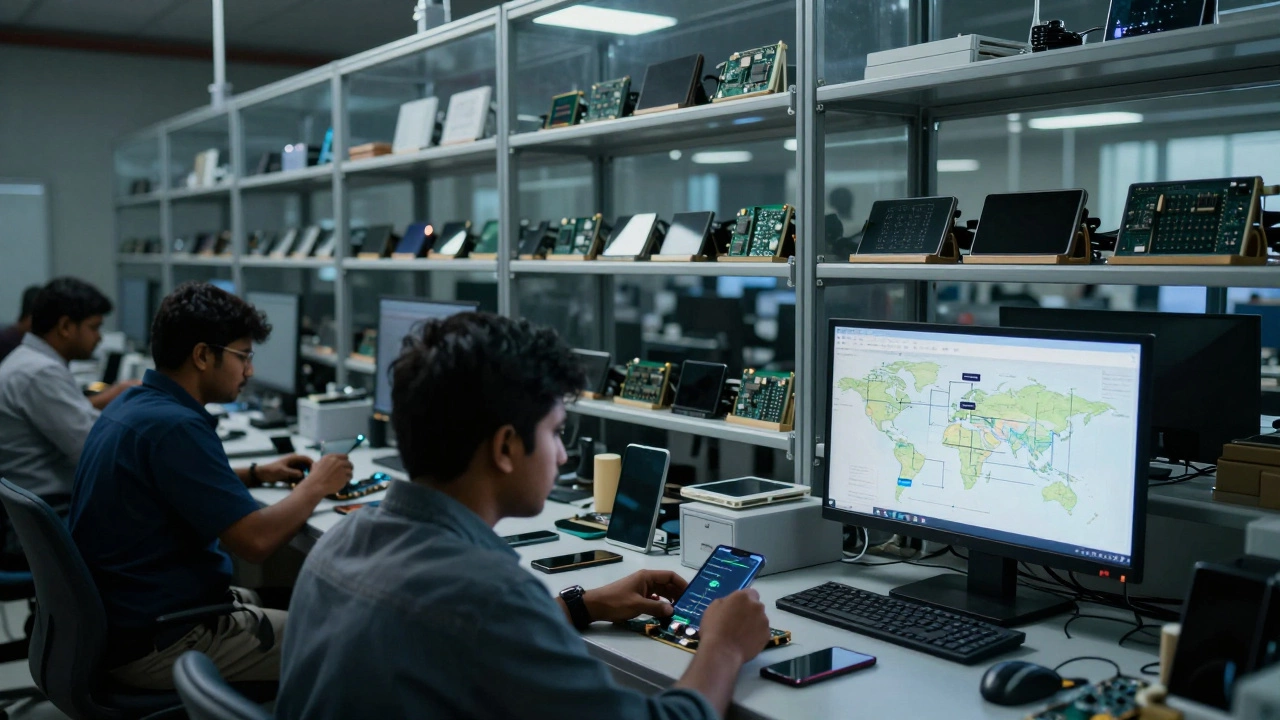
When Apple says it’s moving iPhone production to India, what it really means is: final assembly is happening here. The screens, chips, cameras, and memory? Still shipped from China, South Korea, and Taiwan. India doesn’t have the suppliers to make these parts. There’s no local source for advanced display panels. No domestic producer of printed circuit boards that meet Apple’s quality standards. No foundries to make the processors.
Compare that to Vietnam. They don’t make chips either, but they built a network of small factories that supply connectors, cables, and casings. These suppliers grew alongside big brands. In India, suppliers are treated as afterthoughts. Companies wait for global giants to arrive before investing. By then, the global supply chain has already locked in its partners.
Power isn’t reliable - and it’s not just about outages
You can’t run a high-precision electronics factory on unreliable power. A single voltage dip can ruin thousands of circuit boards. In India, even factories with backup generators face inconsistent frequency and harmonics. A 2023 survey by the Electronics Sector Skill Council found that 68% of electronics manufacturers in Tamil Nadu and Karnataka reported production losses due to power quality issues - not just blackouts.
China’s Shenzhen has industrial zones with dedicated substations, harmonic filters, and real-time voltage monitoring. India’s industrial parks? They’re often connected to the same grid as nearby homes and shops. When a local market turns on its AC units, your production line stutters.
Taxes and compliance eat up margins
India’s tax system looks simple on paper. But in practice, it’s a maze. A factory in Uttar Pradesh might need permits from three different departments - labor, environment, and electricity - each with their own forms, inspections, and fees. One electronics assembler in Pune told me they spent 47 days in 2024 just waiting for environmental clearances. That’s 47 days of no production, no revenue, and payroll still due.
Then there’s GST. While it replaced dozens of state taxes, compliance is still heavy. A small manufacturer must file over 30 returns a year. For a company making 50,000 units a month, that’s a full-time job just to stay compliant. In Malaysia or Thailand, similar companies file quarterly. In India, it’s monthly. And penalties for small errors? Up to 18% of the invoice value.
Skilled labor is missing - not because of education, but because of opportunity
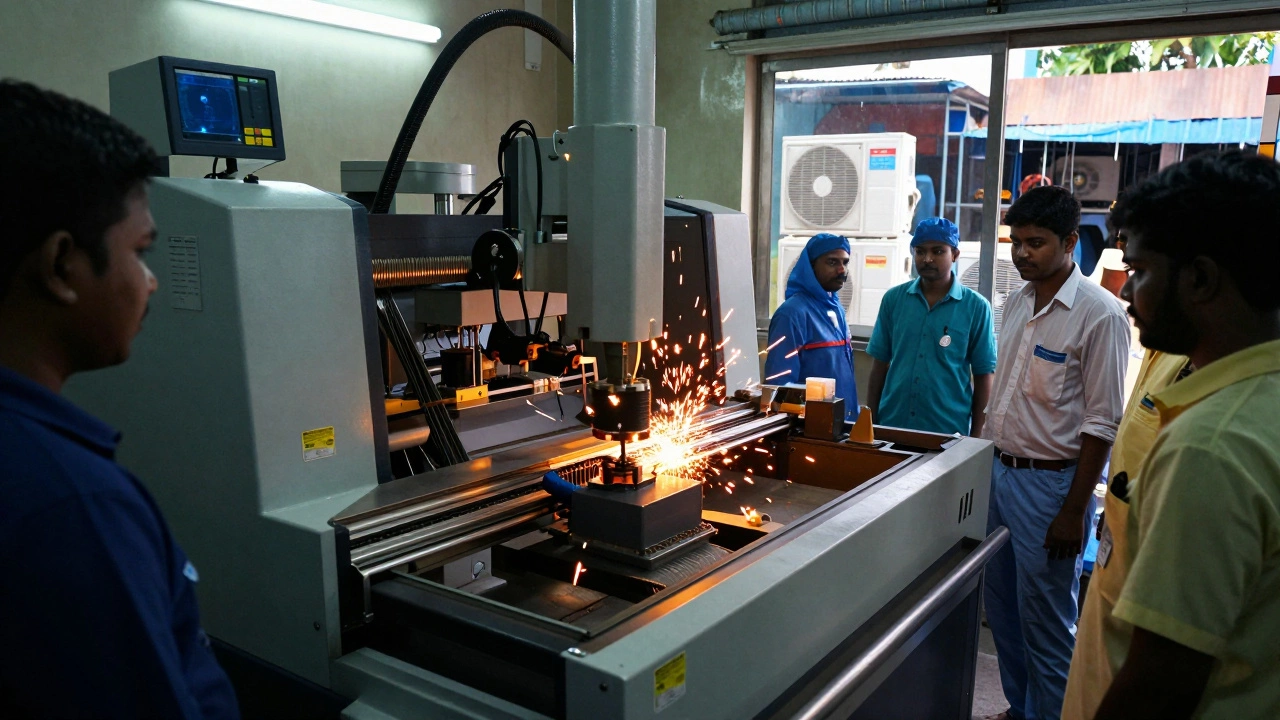
India graduates 1.5 million engineers every year. Yet, factories struggle to find technicians who can calibrate SMT machines or debug firmware on production lines. Why? Because those jobs don’t pay enough to justify the skill.
A senior SMT operator in China earns $1,200 a month. In India, the same role pays $400 - and often without health insurance or overtime pay. Why would someone spend years learning a trade when a call center job pays the same with better hours? The result? Factories hire untrained workers and spend months training them - only to lose them to better-paying gigs in logistics or IT support.
Infrastructure is stuck in the 1990s
Look at a map of India’s industrial zones. Most are still in the same places they were 30 years ago. Roads are narrow. Rail links are overloaded. Ports like Mundra and Nhava Sheva are efficient, but getting goods from there to factories in Telangana or Madhya Pradesh takes days - and costs more than shipping from China.
One company making LED drivers in Hyderabad told me they paid $1.80 to ship a container from Shanghai to their factory. From Mundra Port? $3.20. And the transit time? Four days longer. That’s not logistics - that’s a tax on doing business in India.
Policy swings kill long-term planning
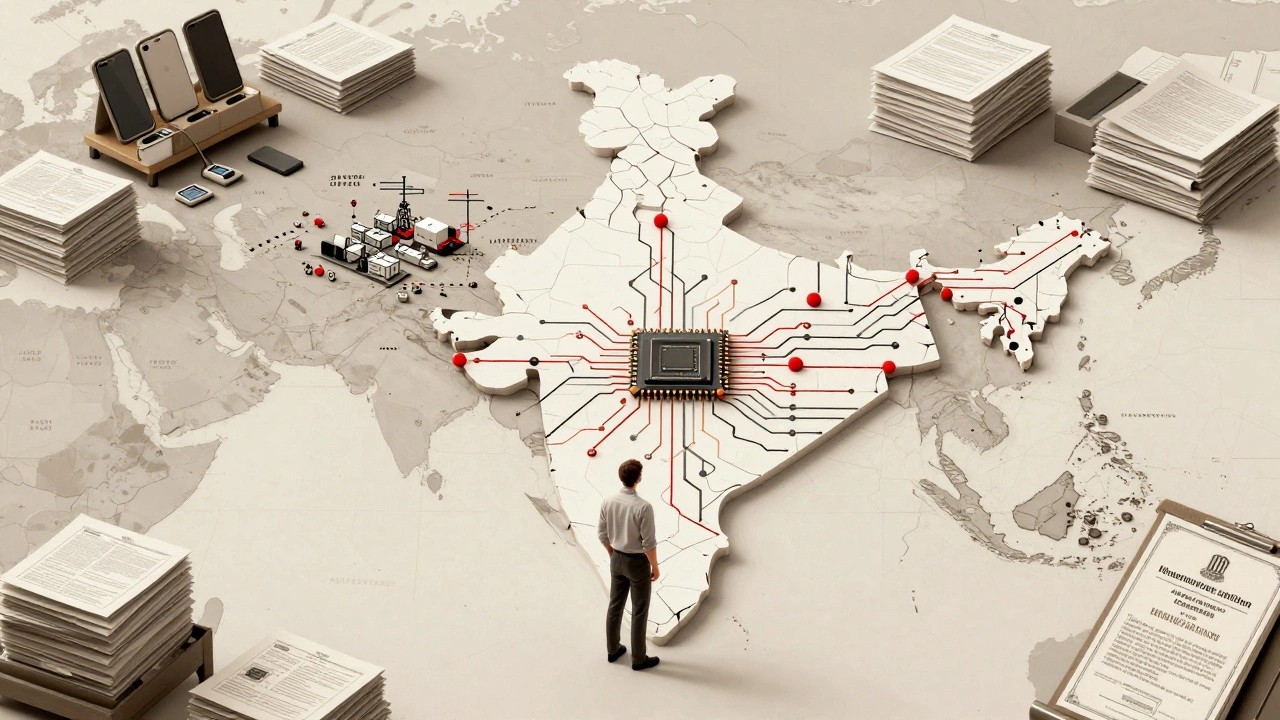
India’s production-linked incentive (PLI) schemes promised $40 billion in subsidies to electronics makers. That sounds great - until you read the fine print. To qualify, companies must hit production targets every year. Miss one? You lose the entire subsidy. No grace period. No negotiation.
Compare that to Vietnam, where incentives are tied to job creation and export growth over five years. India’s approach is like giving someone a car - but only if they drive exactly 100 km every day, no more, no less. One year, they get sick. The car is taken back. That’s not an incentive. It’s a trap.
And then there’s the constant threat of import duty hikes. In 2023, India raised duties on imported circuit boards by 15%. Companies scrambled to find alternatives. But the alternative? Waiting six months for a new supplier to ramp up. Meanwhile, customers canceled orders. Profit margins collapsed.
It’s not about scale - it’s about systems
India has the population. It has the ambition. It has the engineers. But it doesn’t have the systems. Not the supply chains. Not the power grids. Not the skilled workforce pipeline. Not the predictable policies.
When you ask why electronics manufacturing is struggling in India, the answer isn’t corruption or laziness. It’s that every piece of the puzzle was built separately - and never connected. Factories were built to serve global brands, not to create local ecosystems. Incentives rewarded output, not integration. Training programs taught theory, not hands-on repair.
China didn’t become the world’s factory overnight. It started with small workshops making zippers and buttons. Over decades, those grew into suppliers of circuit boards, then chips, then entire devices. India skipped the small steps. It tried to build a Ferrari with bicycle parts.
What’s changing - and what’s not
Some progress is happening. Companies like Dixon Technologies and Tata Electronics are building assembly lines. Startups like Suyash Systems are making simple PCBs. The government is pushing for domestic semiconductor design.
But none of this matters if the power grid stays unreliable. If the tax system stays punishing. If the roads stay congested. If the workers still see no future in factory jobs.
India doesn’t need more slogans. It needs a supply chain that works from the ground up - not one built on top of a broken foundation.
Why can’t India make its own smartphone chips?
India lacks semiconductor fabrication plants (fabs). Building one costs $10 billion and takes 5-7 years. Global leaders like TSMC and Samsung have decades of R&D, supply chains, and skilled labor. India is just starting. Even with government support, it will take at least a decade to produce chips at scale - and only for simpler, older-node technologies.
Is Make in India failing for electronics?
No - but it’s being misunderstood. Make in India succeeded at final assembly. India now makes over 70% of smartphones sold domestically. But assembly isn’t manufacturing. The real challenge is making the components - the chips, sensors, and circuit boards - that give electronics their value. That part is still mostly imported.
Why don’t foreign companies invest more in Indian suppliers?
Because the local supplier base is too fragmented and inconsistent. A company might find 10 small firms making phone cases, but none can deliver 100,000 units a month with zero defects. Global brands need reliability, not volume. They won’t risk their brand on a supplier who can’t meet quality standards consistently.
Can India compete with Vietnam or Thailand in electronics?
Not yet. Vietnam has better logistics, lower compliance costs, and a supplier network built over 20 years. Thailand has strong engineering schools tied to automotive and electronics industries. India’s advantage is scale and domestic demand - but scale alone doesn’t win manufacturing. Systems do.
What’s the biggest myth about electronics manufacturing in India?
That more factories = more manufacturing. India has hundreds of assembly plants. But if they’re just putting together imported parts, they’re not building a manufacturing base - they’re just warehouses with robots. Real manufacturing means designing, sourcing, and producing the core components locally. That’s still missing.
Until India fixes its systems - not just its subsidies - electronics manufacturing will keep struggling. The world doesn’t need another assembly line. It needs a new supply chain. And that starts with the small things: reliable power, fair taxes, skilled workers, and roads that actually connect.