Manufacturing Pillars Assessment Tool
Evaluate your business's strength across the three pillars of manufacturing and get personalized recommendations to improve your operations. This tool is based on the principles discussed in the article about manufacturing's foundation.
People
0%
Recommendation: Focus on employee development and retention strategies. Consider government programs like Manufacturing Advisory Service for skills training support.
Process
0%
Recommendation: Implement Lean methodologies through government programs like Manufacturing Growth Programme. Start with simple visual controls and workflow mapping.
Product
0%
Recommendation: Implement quality control systems and leverage Innovate UK Manufacturing Challenge grants for product innovation.
Your Manufacturing Assessment Results
People
0%
Process
0%
Product
0%
Overall Manufacturing Health
Weak
Strong
When you think about manufacturing, you might picture factories, robots, or assembly lines. But behind every successful manufacturing operation-whether it’s a small workshop in Birmingham or a global plant in Shanghai-are three core principles that hold everything together. These aren’t just buzzwords. They’re the real, measurable foundations that determine if a factory survives, grows, or collapses. And in 2025, with government schemes pushing for resilience and innovation, understanding these pillars isn’t optional-it’s essential.
People: The Human Engine of Manufacturing
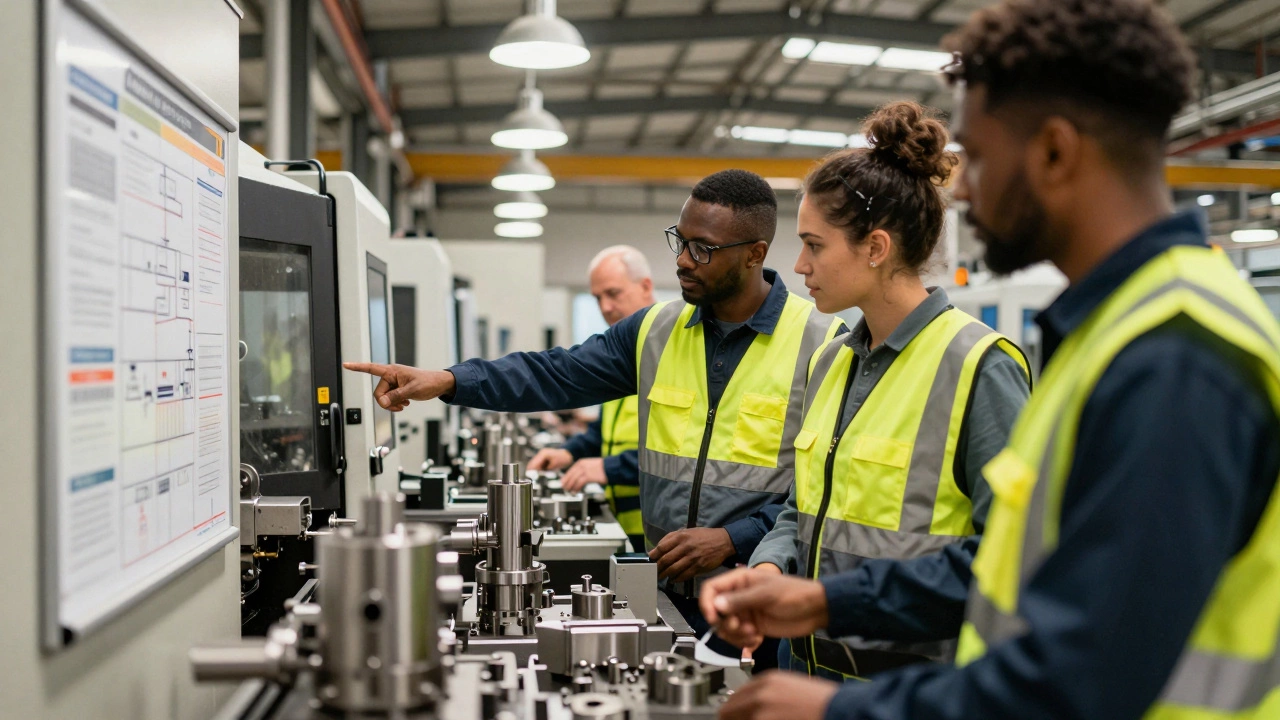
Technology gets all the attention, but the most important part of any manufacturing system is still the person. Skilled workers, supervisors, maintenance teams, and quality inspectors are the ones who spot problems before machines fail, adjust settings on the fly, and make sure a batch of parts meets exact standards. No automation can fully replace human judgment in complex, variable environments.
In the UK, government schemes like the Manufacturing Advisory Service and regional skills grants have poured millions into training programs for welders, CNC operators, and production technicians. Why? Because factories with high turnover or poorly trained staff lose 20-30% more in waste and downtime than those that invest in people. A study by the UK Department for Business and Trade found that manufacturers who provided regular upskilling saw a 22% increase in output over two years-without buying a single new machine.
It’s not about hiring more people. It’s about keeping the right people, giving them the tools to grow, and making them feel valued. Simple things like shift rotation that reduces fatigue, clear feedback systems, and on-the-job mentoring make a bigger difference than flashy new equipment.
Process: Systems That Don’t Break Down
Manufacturing isn’t a series of random actions. It’s a chain of repeatable steps, each one designed to add value. If one step is messy, slow, or inconsistent, the whole line suffers. That’s where process discipline comes in.
Think of a car manufacturer assembling door panels. If the torque on each bolt isn’t exact, doors rattle. If parts arrive late, the whole line stops. Good processes eliminate guesswork. They use standardized work instructions, visual controls, and real-time monitoring to keep things running smoothly.
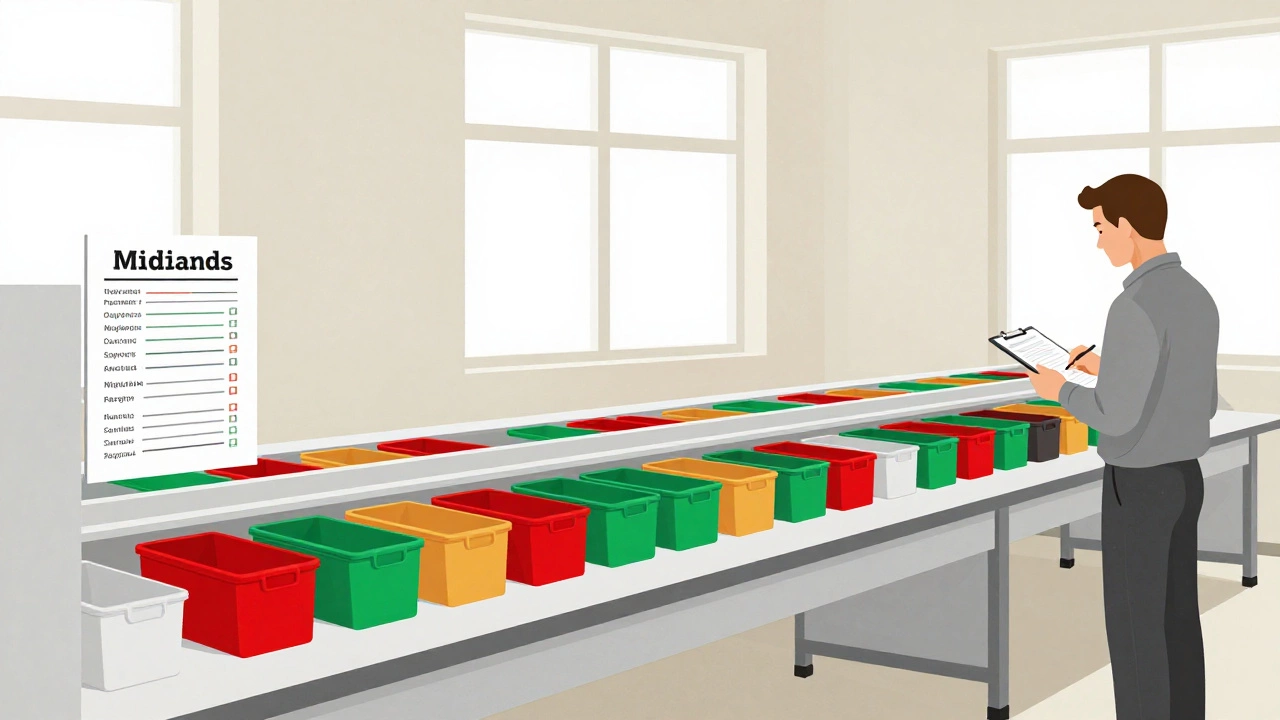
Government-backed initiatives like the Manufacturing Growth Programme help small and medium firms adopt Lean and Six Sigma methods-not as fancy consultants’ jargon, but as practical tools. One Midlands-based food packaging company cut its defect rate by 41% in nine months just by mapping its workflow, eliminating three unnecessary handoffs, and installing simple color-coded bins for parts. No AI. No robots. Just better process design.
Process isn’t about perfection. It’s about predictability. When you know exactly how long each task takes, where bottlenecks form, and how to fix them quickly, you stop reacting and start controlling. That’s what separates manufacturers who thrive from those who barely survive.
Product: Quality That Builds Trust
It doesn’t matter how fast you make something if no one wants to buy it. The third pillar is the product itself-its design, reliability, and consistency. In today’s market, customers don’t just want a part; they want a part that works every single time, fits perfectly, and lasts longer than the competition’s.
Government schemes like the Innovate UK Manufacturing Challenge reward companies that invest in product quality from day one. That means using better materials, tightening tolerances, and testing prototypes under real-world conditions-not just lab conditions. A small electronics maker in Stoke-on-Trent won a £250,000 grant by redesigning a circuit board to handle higher temperatures. Their product failure rate dropped from 8% to 0.7%. Sales doubled in a year.
Quality isn’t just about inspection at the end. It’s built in. That means training staff to stop the line when something’s off, using statistical process control to catch drift before it becomes a defect, and listening to customer feedback-not just surveys, but real complaints and returns.
One of the biggest mistakes manufacturers make is treating quality as a cost center. It’s not. It’s the reason customers come back. A 2024 report from the British Standards Institution showed that manufacturers with ISO 9001 certification and strong quality cultures had 34% higher customer retention than those without.
How the Three Pillars Work Together
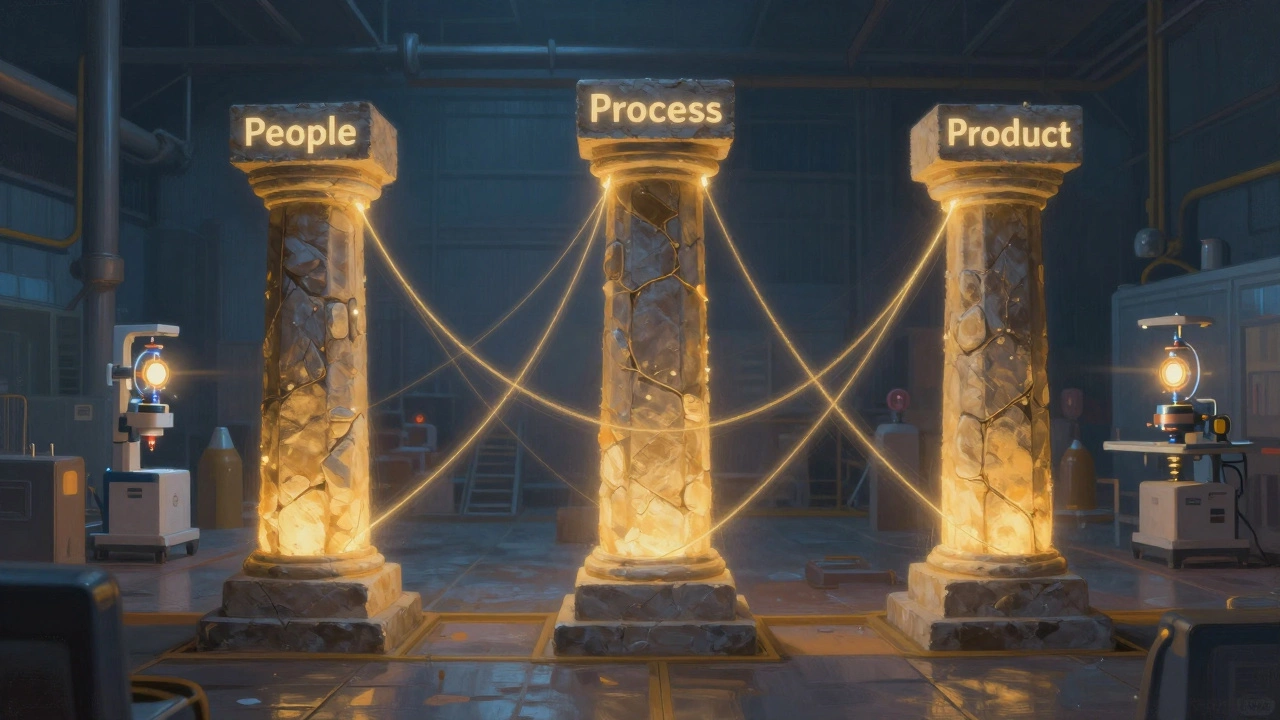
These pillars don’t work in isolation. They feed each other. Better-trained people (People) design and follow better processes (Process), which produce higher-quality products (Product). High-quality products lead to more orders, which require more skilled workers and better processes to meet demand. It’s a cycle.
Take a small firm making medical device components. If they train their staff to spot micro-cracks early (People), use a standardized checklist for cleaning and assembly (Process), and test each batch against strict ISO 13485 standards (Product), they don’t just meet regulations-they become the supplier of choice. That’s how a local business in Wolverhampton went from 12 employees to 68 in five years, all without taking on debt.
Government schemes don’t just give money. They give structure. Programs like the Manufacturing Made Smarter initiative connect firms with mentors, provide free process audits, and fund equipment upgrades-but only if companies show they’re working on all three pillars. You can’t just buy a robot and call it progress. You need the people to run it, the process to guide it, and the product to justify it.
What Happens When One Pillar Fails
Let’s say a factory invests heavily in automation (Process) but doesn’t train its staff (People). The machines break down, and no one knows how to fix them. Downtime spikes. Output drops. The factory loses money.
Or imagine a company makes a great product (Product) but has chaotic workflows (Process). Orders pile up, shipments are late, and customers get frustrated. Even the best product can’t survive inconsistent delivery.
And if you have skilled workers and smooth processes but make a product no one wants? You’re just producing inventory that sits in a warehouse. That’s how companies go from profitable to bankrupt in under 18 months.
The most dangerous myth in manufacturing is that one pillar can save you. It can’t. You need all three.
Where to Start: A Simple Checklist
If you’re running a small or mid-sized manufacturing business and you’re not sure where to focus, use this quick check:
- People: Are your operators getting at least 8 hours of training per year? Do they know how to report problems without fear? Is there a clear path for promotion?
- Process: Are your work instructions written down and posted at each station? Do you track cycle times and downtime daily? Have you eliminated at least one unnecessary step in the last six months?
- Product: Do you track your defect rate by shift? Do you have a system to collect and act on customer feedback? Have you tested your product under real conditions-not just ideal lab settings?
Answering yes to all three? You’re on solid ground. Answering no to one? That’s your next priority.
Final Thought: It’s Not About Scale-It’s About Stability
Manufacturing in 2025 isn’t about being the biggest. It’s about being the most reliable. Governments aren’t funding factories because they want to see more robots. They want to see more jobs, more exports, and more resilience. And the only way to build that is by strengthening the three pillars-people, process, product.
You don’t need a billion-pound investment. You need clarity. You need focus. And you need to stop chasing shiny objects and start building something that lasts.
What are the three pillars of manufacturing?
The three pillars of manufacturing are People, Process, and Product. People refer to skilled, trained, and engaged workers who keep operations running. Process means having clear, repeatable, and efficient workflows. Product is about delivering high-quality, reliable goods that customers trust. All three must work together for sustainable manufacturing success.
Why are the three pillars important for government manufacturing schemes?
Government schemes like the Manufacturing Growth Programme and Innovate UK focus on long-term resilience, not short-term fixes. They fund training, process improvement, and product innovation because these pillars directly reduce waste, increase exports, and create stable jobs. Without them, grants for equipment or automation often fail-because the system around the machine isn’t ready to use it.
Can automation replace the need for strong people in manufacturing?
No. Automation handles repetitive tasks, but it can’t replace human judgment in troubleshooting, adapting to change, or spotting subtle quality issues. Factories that automate without investing in staff end up with expensive machines that sit idle because no one knows how to maintain or optimize them. The best results come from people using technology-not the other way around.
How do I know if my manufacturing process is good enough?
If you can answer these questions: Do you track downtime daily? Are work instructions posted at every station? Have you reduced waste or rework by at least 10% in the last year? Then your process is on track. If you’re guessing, improvising, or relying on one expert to fix everything, it’s not good enough. Good processes are documented, measurable, and repeatable by anyone.
Is product quality just about meeting standards?
Standards are the minimum. Real product quality means exceeding expectations. It’s when customers say, ‘I didn’t expect it to last this long,’ or ‘I’ve tried others, but yours just works better.’ That comes from listening to feedback, testing under real conditions, and caring more about the end result than just ticking boxes on a compliance checklist.
Can small manufacturers afford to focus on all three pillars?
Yes-and they must. You don’t need big budgets. Small manufacturers win by being smarter, not bigger. A £500 training course for operators, a simple visual workflow board, and collecting customer feedback via a QR code on the invoice are low-cost ways to strengthen all three pillars. Many UK small firms have doubled their revenue using just these methods, backed by free advice from government manufacturing advisors.
Start with one pillar. Fix it. Then move to the next. Don’t wait for the perfect moment. The best time to build a strong manufacturing business was years ago. The second-best time is today.