
Manufacturing Factor Assessment Tool
Use this tool to evaluate your manufacturing operation against the 7 critical factors used by government funding schemes. Click the ratings to assess your current status and get actionable recommendations.
When you hear "manufacturing," you might picture factories with loud machines and workers in hard hats. But the real secret to successful manufacturing isn’t just about machines-it’s about seven key factors that make or break every production line, especially if you’re applying for government support or running a small-scale operation. These aren’t theoretical ideas. They’re the same factors inspectors, grant evaluators, and plant managers check every day across the UK and beyond.
1. Raw Material Availability and Quality
You can have the best machine in the world, but if your raw materials are late, inconsistent, or too expensive, your whole operation stalls. In manufacturing, material supply isn’t just a logistics issue-it’s a financial one. For example, a Birmingham-based metal fabricator applying for a UK government manufacturing grant had their application rejected because they couldn’t prove a stable supply of certified aluminium. They switched from three unreliable suppliers to one certified UK-based mill, and their production yield jumped 22% in six months.
Government schemes often require proof of local sourcing. If you’re using imported materials, you need documentation showing lead times, quality certifications (like ISO 9001), and cost stability. Don’t assume your supplier is good enough-track their on-time delivery rate. Anything below 95% is a red flag.
2. Production Efficiency and Throughput
Efficiency isn’t about working faster-it’s about producing more with less waste. Think of it like your car’s fuel economy: you want the most output per unit of input. In manufacturing, that means minimizing scrap, reducing machine downtime, and cutting unnecessary steps in your workflow.
A small electronics assembler in Stoke-on-Trent used to lose 18% of their circuit boards to soldering errors. They didn’t buy new machines. They mapped their entire assembly line, found one bottleneck where operators waited 12 minutes between tasks, and reorganized the layout. Their throughput increased by 31% without adding staff or equipment. That’s the kind of win that gets you noticed by grant reviewers.
Track your OEE-Overall Equipment Effectiveness. It’s a simple formula: Availability × Performance × Quality. If your OEE is below 65%, you’re leaving money on the table. Top performers hit 85% or higher.
3. Labour Skills and Training
Manufacturing isn’t a job you can hand off to just anyone. Even with automation, skilled workers are the backbone of quality control, troubleshooting, and continuous improvement. Many government schemes now require proof of staff training programs-not just a one-time safety course, but ongoing skill development.
In 2024, the UK’s Advanced Manufacturing Skills Initiative gave priority to businesses that had certified apprenticeships or partnerships with local colleges. One Sheffield toolmaker partnered with a nearby FE college to train five new CNC operators over 12 months. They didn’t just get funding-they kept those workers for five years. Turnover dropped by 40%.
Don’t wait for a crisis to train your team. Build a simple internal certification system: basic machine operation → advanced maintenance → process improvement. Track who’s certified and when they need refresher training.
4. Technology and Automation Level
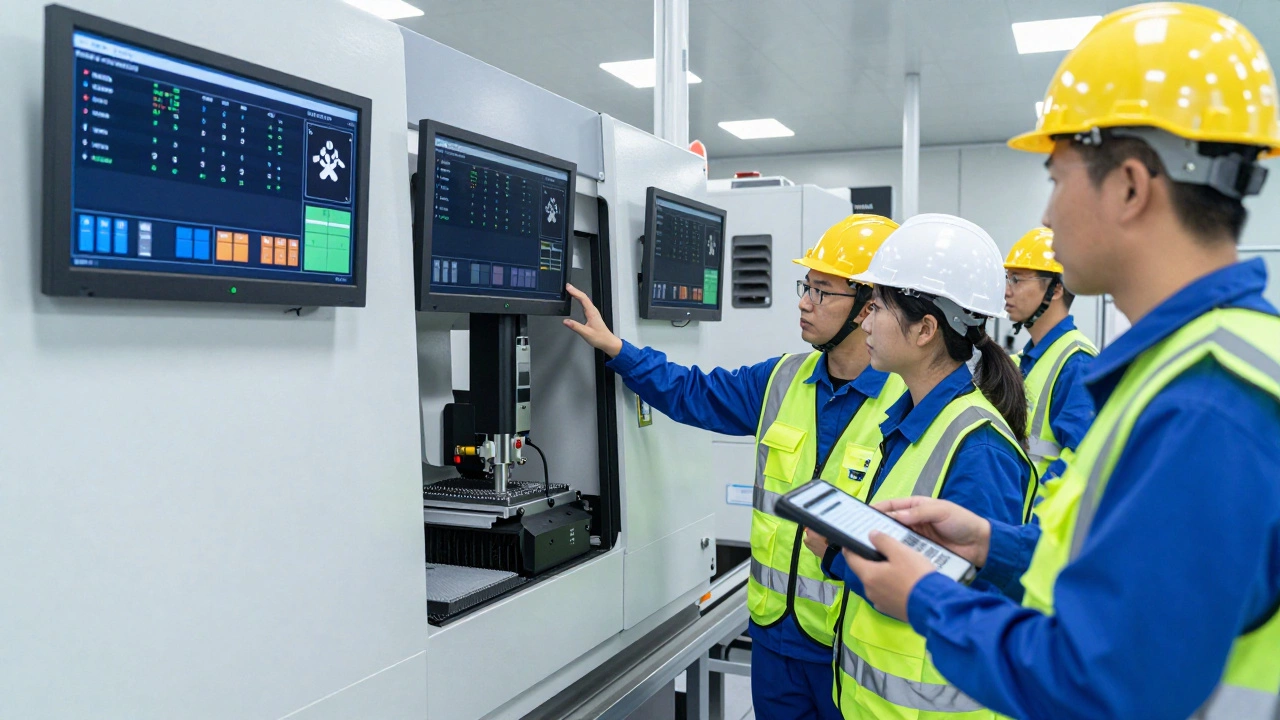
Automation doesn’t mean replacing people with robots. It means using the right tech to remove repetitive, error-prone tasks. A CNC machine that cuts metal to within 0.01mm? That’s automation. A barcode scanner that logs every component as it moves through assembly? That’s automation too.
Government schemes like the UK’s Manufacturing Growth Programme offer grants for tech upgrades-but only if you can show a clear return on investment. Don’t say "we want a robot." Say: "We’re installing vision inspection systems to reduce quality rejects by 25%, saving £18,000 annually in rework costs."
Start small. If you’re still using paper work orders, switch to a digital shop floor system. If you’re manually measuring parts, invest in a digital caliper with data output. These aren’t flashy, but they’re exactly what evaluators look for.
5. Cost Control and Financial Sustainability
Manufacturing is a numbers game. You can have perfect quality and high output, but if your costs eat up your profit margin, you won’t survive. This is where many small manufacturers fail-even after getting government funding.
Track your cost per unit. Break it down: materials, labour, overhead, energy, maintenance. Then compare it to your selling price. If your cost is 85% of your price, you’re in danger. Top performers keep it under 70%.
One food packaging business in Leicester cut energy costs by 22% just by switching to LED lighting and installing motion sensors on their packaging lines. They used the savings to pay for a new sealing machine. That’s smart cost control. That’s what grant panels want to see.
6. Quality Assurance and Compliance
Quality isn’t just about making good products. It’s about proving you can do it consistently. If you’re selling to big brands, exporting, or applying for government contracts, you need documented quality systems.
ISO 9001 isn’t optional anymore. It’s the baseline. Even small manufacturers need a quality manual, inspection checklists, non-conformance logs, and corrective action records. A manufacturer in Coventry was denied a £50,000 innovation grant because they didn’t have a traceability system for batch numbers. They couldn’t prove which parts went into which product. That’s a compliance failure.
Start simple: assign a quality checker for each shift. Use a free template from the UK’s Department for Business and Trade. Record every defect, who found it, and how it was fixed. After three months, you’ll see patterns-and you’ll be ready for certification.
7. Market Demand and Customer Feedback
Here’s the truth no one tells you: you can do everything right and still fail if no one wants your product. Manufacturing is not a closed loop. It’s connected to customers, trends, and timing.
A furniture maker in Birmingham started making custom wooden desks after noticing a surge in remote work orders. They didn’t wait for a grant-they surveyed 50 local home offices, built three prototypes, and tested pricing. Within six months, they were selling 40 units a month. That real-world demand made them eligible for a regional growth grant.
Don’t assume you know what customers want. Ask them. Use simple tools: Google Forms, WhatsApp polls, or even handwritten feedback cards at delivery. Track repeat orders. If your customer retention rate is below 60%, your product or service isn’t hitting the mark.
How These Factors Tie Into Government Schemes
Government manufacturing schemes don’t give money to people who say "I need help." They give it to people who can prove they’ve got these seven factors under control. Whether it’s the UK’s Made Smarter programme, the Regional Growth Fund, or local council grants, the evaluation criteria are always the same:
- Can you show measurable improvements in efficiency?
- Do you have trained staff and a plan to grow them?
- Are your costs sustainable and your quality reliable?
- Is there real market demand behind your product?
If you’re applying for funding, don’t just fill out the form. Build a one-page summary that answers each of these seven factors with numbers. For example:
"Our OEE improved from 58% to 79% after reorganizing our assembly line. Labour turnover dropped from 35% to 12% after launching a skills certification program. We’ve secured three new clients through direct feedback surveys, increasing annual revenue by £120,000."
That’s the kind of clarity that gets funding approved.
What Happens When One Factor Fails?
Let’s say your materials are perfect, your staff are skilled, and your tech is modern. But your quality control is sloppy. You’ll get returns. You’ll lose customers. Your reputation tanks. That’s one factor breaking the whole chain.
Or your demand is strong, but your costs are out of control. You’re selling units, but you’re losing money on each one. You’ll burn through cash fast-even if you’re "growing."
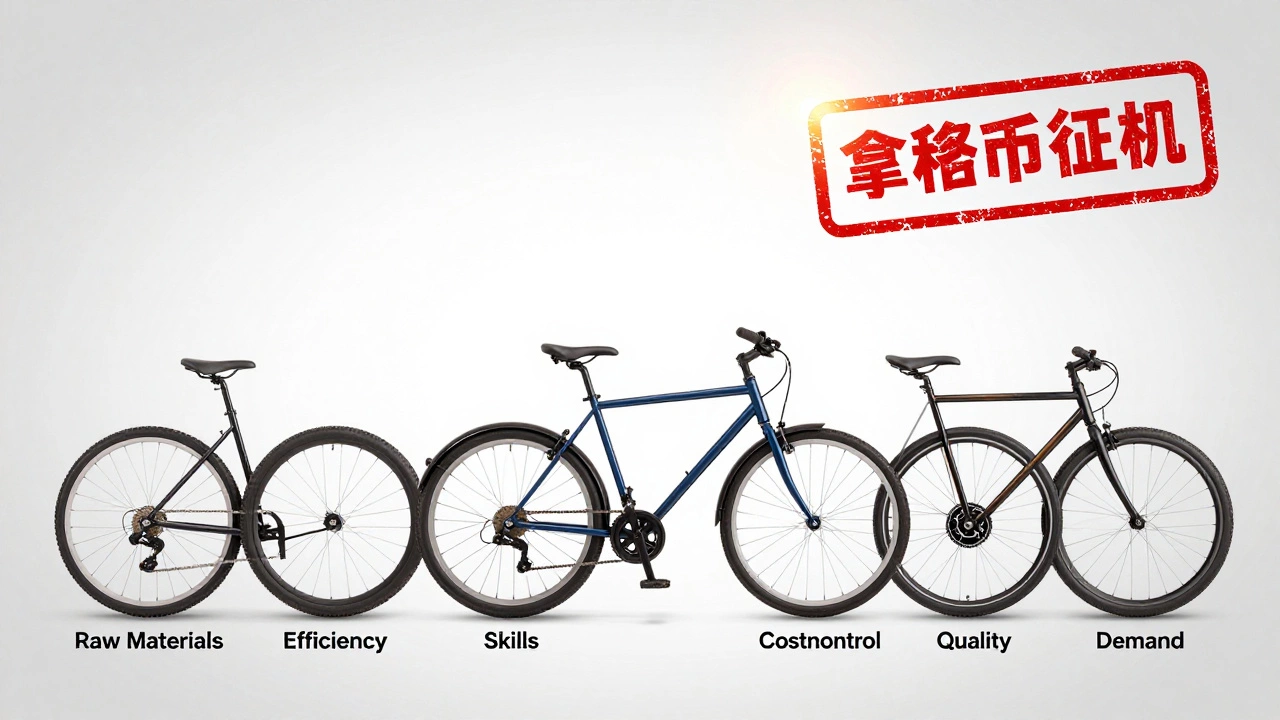
Manufacturing is like a bicycle. All seven wheels need to turn together. If one stops, you fall. That’s why successful manufacturers don’t fix one thing at a time. They audit all seven factors every quarter.
Where to Start: A Simple 30-Day Action Plan
Don’t try to fix everything at once. Pick one factor that’s hurting you the most and tackle it in 30 days.
- Week 1: Pick your weakest factor (e.g., quality control or cost per unit).
- Week 2: Collect data. How many defects? What’s your OEE? What’s your material cost per unit?
- Week 3: Find one low-cost fix. Swap a supplier? Train one person? Install a simple sensor?
- Week 4: Measure the result. Did it improve? By how much?
After 30 days, you’ll have proof-real numbers-that you’re improving. That’s the first step to getting funding, winning contracts, or scaling your business.
Final Thought: Manufacturing Is a System, Not a Machine
There’s no magic tool, no secret software, no government grant that will save you if your system is broken. But if you understand these seven factors-and you’re actively managing them-you’re already ahead of 80% of small manufacturers.
You don’t need to be the biggest. You just need to be the most consistent. The rest will follow.
What are the 7 factors of manufacturing?
The seven key factors are: 1) Raw material availability and quality, 2) Production efficiency and throughput, 3) Labour skills and training, 4) Technology and automation level, 5) Cost control and financial sustainability, 6) Quality assurance and compliance, and 7) Market demand and customer feedback. These factors determine whether a manufacturing operation is profitable, scalable, and eligible for government support.
Why are these factors important for government manufacturing schemes?
Government schemes don’t just give money to businesses that ask for it-they invest in those who can prove they’re managing core operational risks. These seven factors are the exact criteria used to evaluate applications. If you can show measurable progress in each area, you’re far more likely to get funding, grants, or tax incentives.
Can small manufacturers benefit from these factors too?
Yes-often more than large companies. Small manufacturers are more agile. Fixing one factor, like switching to a better supplier or training one operator, can have a huge impact. Many UK grants specifically target small and medium-sized manufacturers because they’re the backbone of local economies.
How do I measure production efficiency?
Use Overall Equipment Effectiveness (OEE). It’s calculated by multiplying Availability (how often the machine runs) × Performance (how fast it runs) × Quality (how many good parts it makes). A score above 85% is excellent. Below 65% means you have serious room for improvement.
Do I need ISO 9001 to get government funding?
Not always, but you need something equivalent. Most schemes require documented quality processes-like inspection checklists, defect logs, and corrective action records. ISO 9001 is the gold standard, but even a simple, well-maintained quality manual can meet the minimum requirements for smaller grants.
What’s the cheapest way to improve manufacturing?
Start with your people. A 2-hour training session to reduce a common error can save more than buying a new machine. Also, track your energy use-switching to LED lighting or turning off idle equipment can cut costs by 15-25% overnight. The best improvements are often low-cost and high-impact.