Precision Requirements Checker
Select a Food Processing Task
Precision Requirements
Select a task to see precision requirements
Why precision matters: In food processing, even small measurement errors can lead to safety issues, regulatory violations, or financial losses. For example, a 2°C error in pasteurization could mean unsafe food and costly recalls.
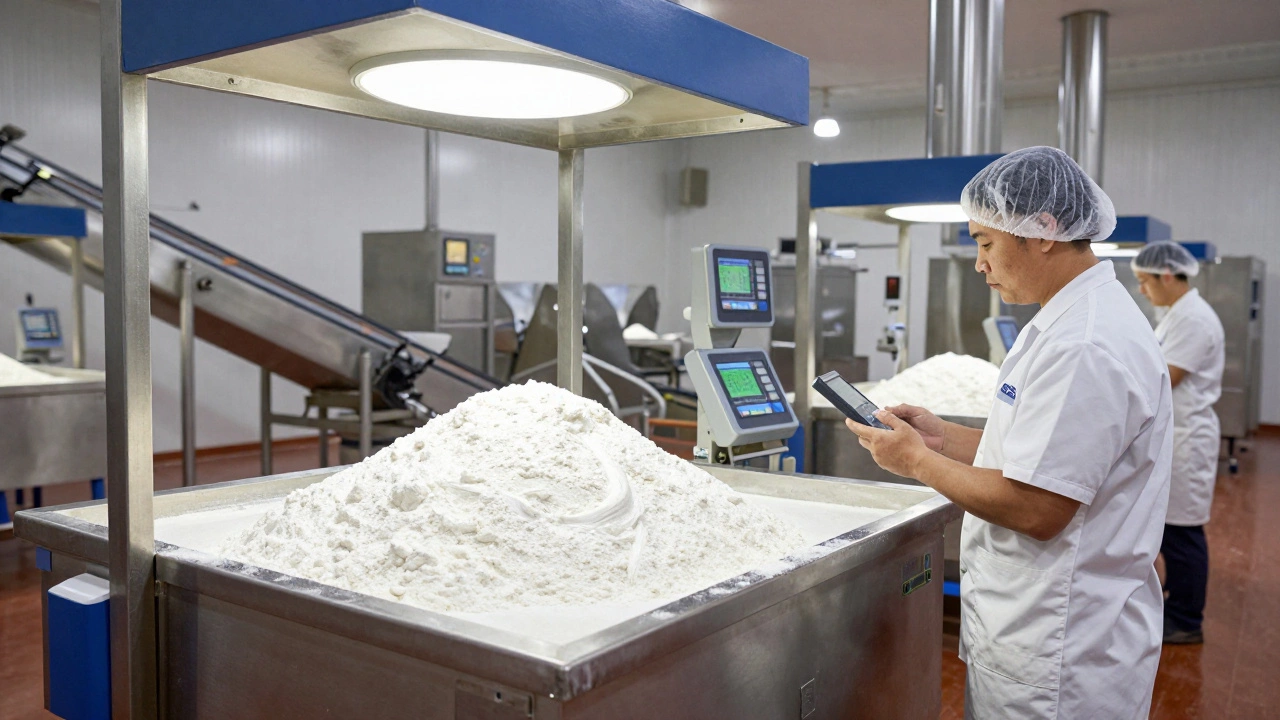
When you walk into a food processing plant, you don’t just see machines and conveyor belts. You’re stepping into a world ruled by numbers. Every step - from weighing raw ingredients to timing pasteurization - depends on precise measurements. Get one unit wrong, and you risk spoilage, safety issues, or regulatory fines. In food processing, units of measurement aren’t just technical details; they’re the backbone of quality, safety, and efficiency.
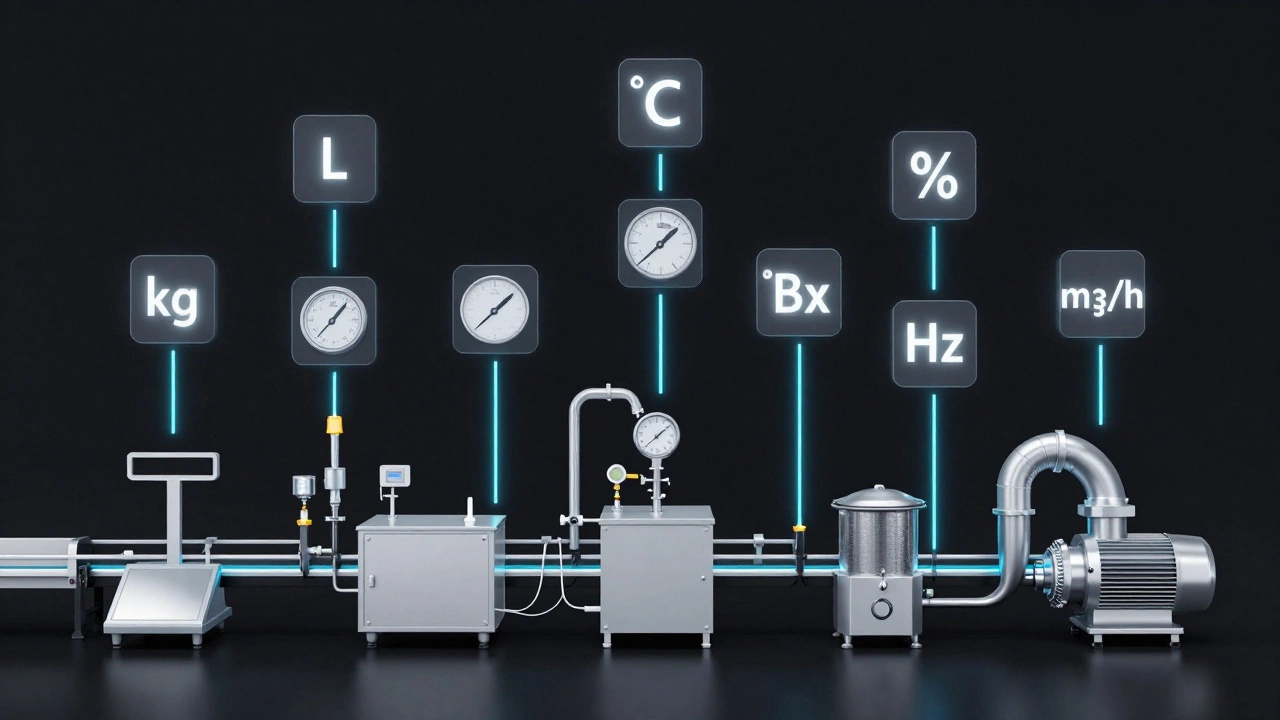
1. Kilogram (kg)
The kilogram is the most common unit for weighing raw materials like flour, sugar, meat, and vegetables. In large-scale operations, batch sizes are measured in hundreds or thousands of kilograms. For example, a bakery making 5,000 loaves a day might use 1,200 kg of flour per shift. Scales in these facilities are calibrated daily to ensure accuracy within ±5 grams. Any drift beyond that can throw off recipes, waste product, or violate labeling laws.
2. Liter (L)
Liquids - milk, oil, syrups, brines - are measured in liters. A dairy plant filling 100,000 cartons of milk daily uses volumetric flow meters to track output in liters per minute. Pasteurization tanks hold specific volumes, often 500 L or 1,000 L, to ensure consistent heat treatment. Underfilling means lost revenue; overfilling means wasted product and potential leakage during transport.
3. Degree Celsius (°C)
Temperature control is non-negotiable in food safety. Refrigerated storage runs at 2°C to 4°C. Freezers stay at -18°C or lower. Pasteurization hits 72°C for 15 seconds. Cooking processes like frying chicken require surface temps above 74°C to kill pathogens. Thermocouples and infrared sensors monitor these values in real time. A single degree off in a retort (steam sterilizer) can mean the difference between safe food and a recall.
4. Second (s) and Minute (min)
Time is a measurement too. Conveyor belt speeds, cooking cycles, and sterilization durations are all timed precisely. A pasta extruder might run for 90 seconds per batch. A vacuum sealer holds vacuum for 12 seconds to remove oxygen. Even packaging lines use timers to space out product flow - 2 seconds between each bottle on a bottling line. Miss a timing window, and you get clumped products, undercooked items, or jammed machinery.
5. Pounds per Square Inch (psi)
Pressure matters in canning, extrusion, and filtration. Canned foods are sealed under 15-20 psi of steam pressure to kill botulism spores. High-pressure processing (HPP) machines use up to 87,000 psi to preserve juices without heat. Air pressure in pneumatic conveyors moves powdered ingredients like cocoa or spices through pipes. If pressure drops below 30 psi in a spice line, material builds up and clogs the system - halting production.

6. Degrees Brix (°Bx)
This measures sugar content in liquids. It’s critical in fruit juices, soft drinks, jams, and syrups. A tomato sauce might need 8-10°Bx for the right balance. A soda recipe calls for 11.5°Bx. Refractometers are used on the line to check samples every 30 minutes. Too low, and the product tastes flat. Too high, and it’s overly sweet - or worse, attracts microbes that thrive in sugary environments.
7. Percent (%)
Percentages track composition, moisture, and yield. Meat products must list fat content - say, 15% fat in ground beef. Moisture levels in dried fruits like raisins must stay below 18% to prevent mold. Yield percentages show how much finished product you get from raw input - for example, 85% yield from whole chicken to boneless breasts. If yield drops below 80%, you’re losing money on waste or shrinkage.
8. Micrometers (μm)
Particle size matters in powdered ingredients. Flour, milk powder, and spice blends are ground to specific micron ranges. A bakery might require flour at 100-150 μm for optimal texture. Too coarse, and the dough doesn’t rise evenly. Too fine, and it clumps or clogs filters. Laser diffraction analyzers measure this daily. In pharmaceutical-grade food additives, particle size must be under 50 μm to ensure even mixing.
9. Hertz (Hz)
Hz measures frequency - mostly in motors and vibratory equipment. A vibrating sieve that separates granules might run at 30 Hz. A mixer’s agitator rotates at 60 Hz. If the motor runs at 58 Hz instead of 60, the mixing time increases, slowing down the whole line. Frequency converters are used to fine-tune speed, especially in automated systems that sync multiple machines.
10. Cubic Meters per Hour (m³/h)
This tracks airflow in drying systems and ventilation. In spray drying, air flows at 1,200-2,500 m³/h to evaporate moisture from milk or coffee extract. In cold storage, air exchange rates must hit 10-15 m³/h per cubic meter to control humidity and prevent condensation. Too little airflow, and mold grows. Too much, and product dries out or loses flavor. Flow meters are installed in ducts and monitored continuously.
Why These Units Matter Beyond the Numbers
These ten units aren’t just technical specs - they’re legal requirements. The FDA, EFSA, and local food safety agencies set standards based on them. A canning plant that doesn’t hit 121°C for 3 minutes fails inspection. A juice producer using 9°Bx instead of 11°Bx mislabels sweetness and risks consumer complaints. In the UK, the Weights and Measures Act requires all food labeling to reflect accurate measurements in metric units.
Even small processors can’t ignore this. A local jam maker using kitchen scales and measuring cups might think they’re fine. But if they sell to supermarkets or online, their labels must match the same standards as big brands. Training staff to read gauges, calibrate instruments, and log readings isn’t optional - it’s survival.
Common Mistakes and How to Avoid Them
- Calibration drift: Scales and thermometers lose accuracy over time. Check them weekly. Use certified reference weights and temperature baths.
- Unit confusion: Mixing imperial and metric - like using cups instead of liters - leads to recipe errors. Standardize on metric across all documentation.
- Ignoring tolerance: Saying “add 5 kg” without specifying ±0.1 kg invites inconsistency. Always define acceptable ranges in SOPs.
- Manual logging: Writing down readings on paper? That’s a risk. Use digital data loggers that auto-record and timestamp measurements.
What Happens When Units Are Ignored?
In 2023, a UK-based frozen meal producer recalled 120,000 units because their oven temperature sensor was off by 7°C. The food didn’t reach the required 75°C core temperature. The company lost £2.3 million in recalls, fines, and lost contracts.
Another case: a juice bottler used a refractometer calibrated in Brix but reported values in % sugar. The difference? 1°Bx equals roughly 0.6% sugar. Their labels said “10% sugar” when it was really 16.7%. Customers complained of excessive sweetness. The brand’s reputation took a hit.
These aren’t hypotheticals. They happen every year. And they’re always preventable.
How to Build a Measurement Culture
Start with documentation. Every process should have a Standard Operating Procedure (SOP) that lists:
- The unit used
- The acceptable range
- The tool required
- How often to check
- Who’s responsible
Train everyone - from line workers to managers - on what these units mean and why they matter. Use visual aids: posters showing correct thermometer placement, laminated cheat sheets for scale readings.
Invest in simple digital tools. A £200 calibrated digital scale with data output beats ten old analog ones. A £500 temperature logger with cloud alerts saves thousands in potential recalls.
Final Thought: Precision Isn’t Optional
Food processing isn’t about guesswork. It’s about control. The difference between a safe product and a dangerous one often comes down to a single decimal point. Whether you run a small family-owned kitchen or a multinational plant, these ten units are your foundation. Master them, and you master quality. Ignore them, and you risk everything.
What are the most important units of measurement in food processing?
The most critical units are kilogram (kg) for weight, liter (L) for volume, degree Celsius (°C) for temperature, second/minute (s/min) for time, and degrees Brix (°Bx) for sugar content. These directly impact safety, quality, and compliance. Missing any one can lead to spoilage, recalls, or legal penalties.
Why is calibration so important in food processing?
Calibration ensures your tools - scales, thermometers, pressure gauges - give accurate readings. A scale off by 100 grams on a 500 kg batch means 20% too much or too little ingredient. That affects taste, cost, and safety. Most regulations require daily or weekly checks. Uncalibrated tools are the #1 cause of batch failures in small plants.
Can I use cups and spoons instead of metric units in small-scale food processing?
For personal use, yes. For commercial sale, no. UK and EU law require all food labels to use metric units (grams, liters, °C). Using cups and spoons may work in your kitchen, but if you sell to stores or online, your packaging must show exact metric values. Inspectors will reject non-compliant labels.
What tools are used to measure these units in food plants?
Digital scales for kg, volumetric flow meters for liters, thermocouples and infrared sensors for °C, refractometers for °Bx, pressure transducers for psi, laser particle analyzers for micrometers, and digital timers for seconds. Many modern plants use integrated systems that auto-record and alert if values go out of range.
How do I know if my measurements are legally compliant?
Check your local food safety authority’s guidelines - in the UK, that’s the Food Standards Agency. They require metric units on all labels, accurate weight and volume measurements, and documented calibration records. Keep logs for at least two years. If you’re unsure, hire a certified metrology auditor to review your systems.