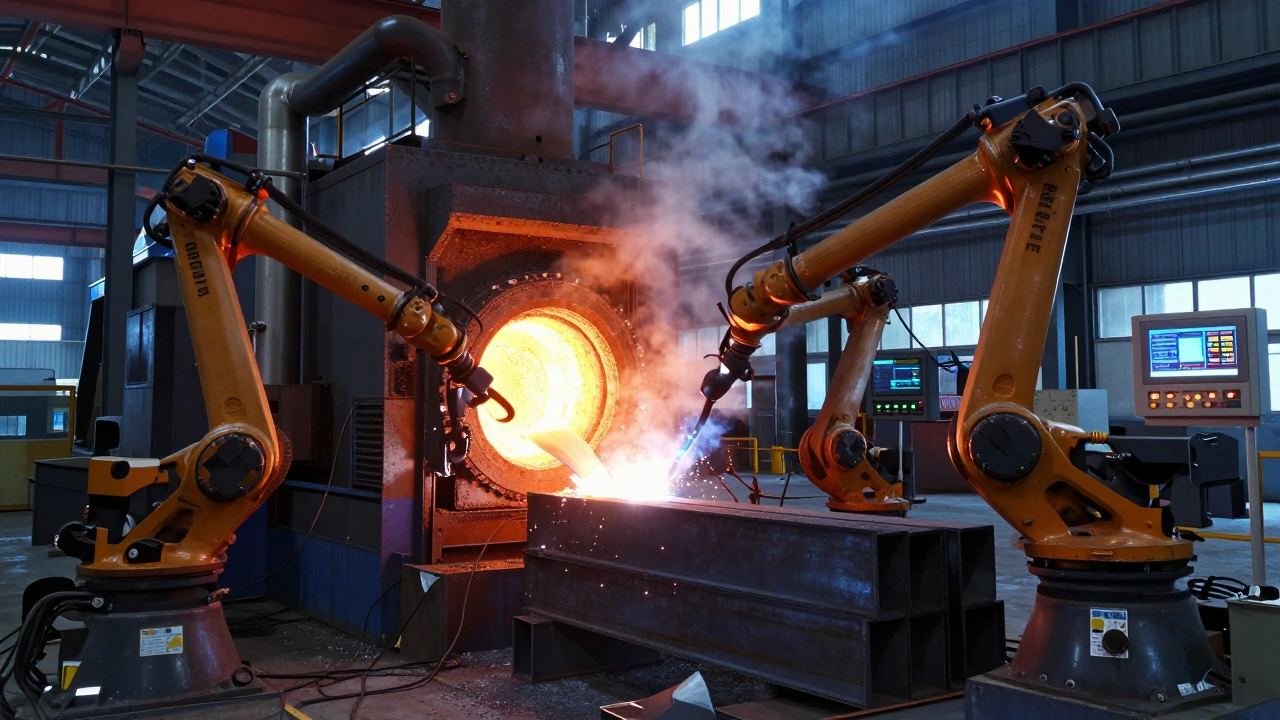
When you hear "Made in the USA" on a car, a refrigerator, or a bridge, do you ever wonder if the steel inside it was actually made in the United States? The answer isn’t as simple as yes or no. The US doesn’t just make steel anymore-it still makes a lot of it. But the scale, the methods, and the markets have changed dramatically since the heyday of Pittsburgh and Gary, Indiana.
Steel production in the US today
In 2025, the United States produced about 79 million metric tons of crude steel. That’s not a record high, but it’s more than enough to supply nearly all of its own construction, automotive, and machinery needs. For comparison, China made 1 billion tons that same year. The US doesn’t compete on volume-it competes on quality, specialization, and efficiency.
The country has 140 active steel mills, down from over 300 in the 1980s. But each one today is far more productive. Modern electric arc furnaces (EAFs) use recycled scrap steel instead of raw iron ore and coal. These mills account for 70% of US production. They’re faster, cleaner, and cheaper to run. The rest come from integrated mills like ArcelorMittal’s facility in East Chicago, which still uses blast furnaces but runs on natural gas and advanced automation.
Where does the steel come from?
It’s easy to assume that because imports exist, domestic production has vanished. But imports make up only about 15% of the steel used in the US each year. The rest comes from home. The biggest steel-producing states are Texas, Pennsylvania, Ohio, Indiana, and Alabama. Birmingham, Alabama, for example, is home to one of the largest mini-mills in the country-Nucor’s facility that turns scrap into rebar for highways and skyscrapers.
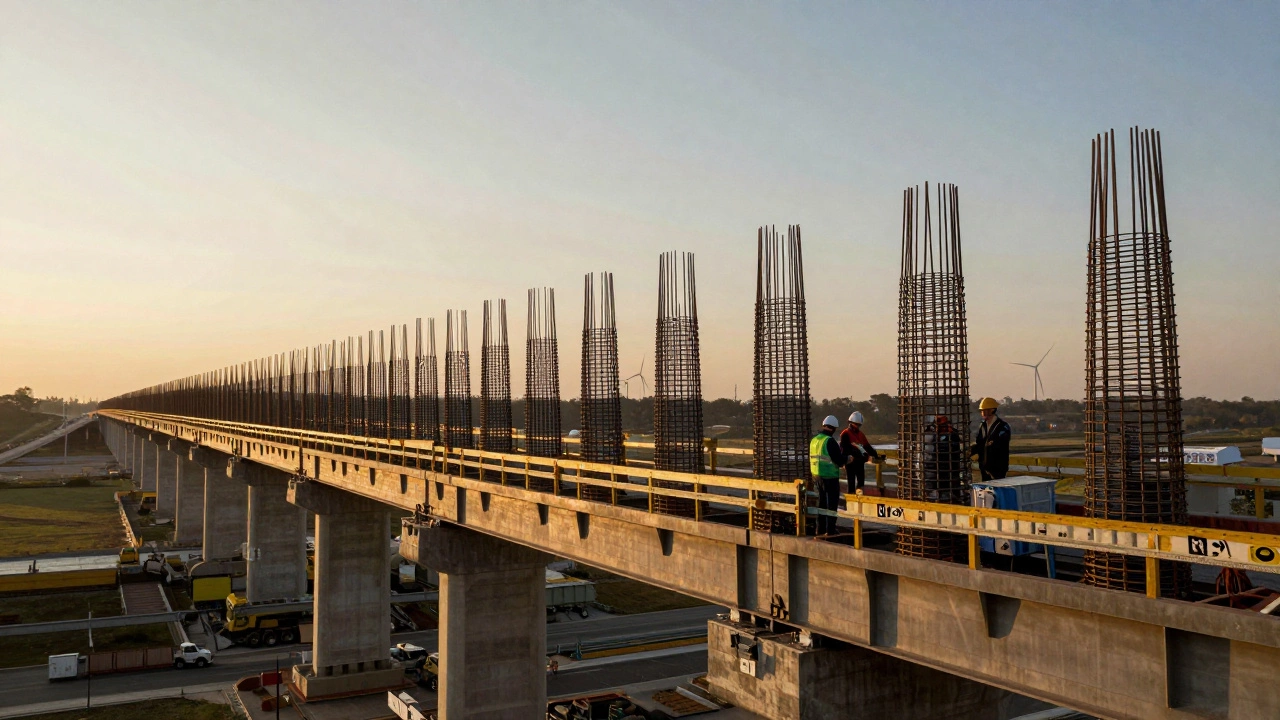
When you see a new bridge in Texas or a wind turbine tower in Iowa, chances are the steel came from a plant less than 500 miles away. The US doesn’t import steel for most infrastructure projects. Federal law requires it for federally funded projects under the Buy American Act. That means even if a company in Germany can make cheaper steel, it can’t win a contract for a US highway unless it’s made here.
Why the myths persist
Many people think the US stopped making steel because factories closed. And yes, they did-especially in the Rust Belt. But those closures weren’t because the industry died. They were because outdated, union-heavy, inefficient mills couldn’t compete with modern, lean operations. The workers didn’t vanish-they moved to newer plants, got retrained, or shifted into engineering and robotics roles.
Another myth is that all steel is imported from China. That’s not true. Less than 2% of US steel imports come from China. Most come from Canada, Mexico, Brazil, and South Korea. Even then, those imports are mostly specialty products-like high-grade stainless steel for medical devices or ultra-thin sheets for electronics-that US mills don’t produce in large volumes.
Who’s making steel in the US now?
The big names haven’t disappeared-they’ve evolved. Nucor, based in North Carolina, is now the largest steel producer in the country. It operates 28 mills across 14 states, all using EAF technology. Nucor’s mills run on 100% scrap, use 75% less energy than old blast furnaces, and have zero emissions at the point of production. They’ve also built robotic welding lines and AI-driven quality control systems.
Steel Dynamics in Indiana is another powerhouse. It makes structural beams for skyscrapers and rail tracks for Amtrak. Its Flat Roll Division produces the steel used in Tesla’s Model Y frames. And then there’s U.S. Steel, which still runs the last major blast furnace in the Midwest. It’s not obsolete-it’s modernized. The company spent $2 billion upgrading its Mon Valley Works in Pennsylvania to cut emissions by 30% and increase output by 25%.
The future of American steel
The US steel industry is at a turning point. The Inflation Reduction Act of 2022 gave $15 billion in tax credits for clean steel production. Companies are now racing to build hydrogen-powered furnaces and carbon capture units. By 2030, the goal is to have at least three green steel plants operating-using hydrogen instead of coal to reduce iron ore.
And demand isn’t slowing down. Wind turbines need more steel per unit than oil rigs. Electric vehicles use 30% more steel than gas-powered ones. The Defense Department is ordering 500,000 tons of high-strength steel for next-gen tanks and ships. Infrastructure bills are pouring billions into bridges, rail, and power grids-all of which require American-made steel.
The US doesn’t make steel like it did in 1950. But it makes better steel. Stronger. Cleaner. More precise. And it’s still the backbone of American industry.
What gets imported-and why
Not all steel is created equal. The US imports about 12 million tons a year, mostly for two reasons: specialization and cost.
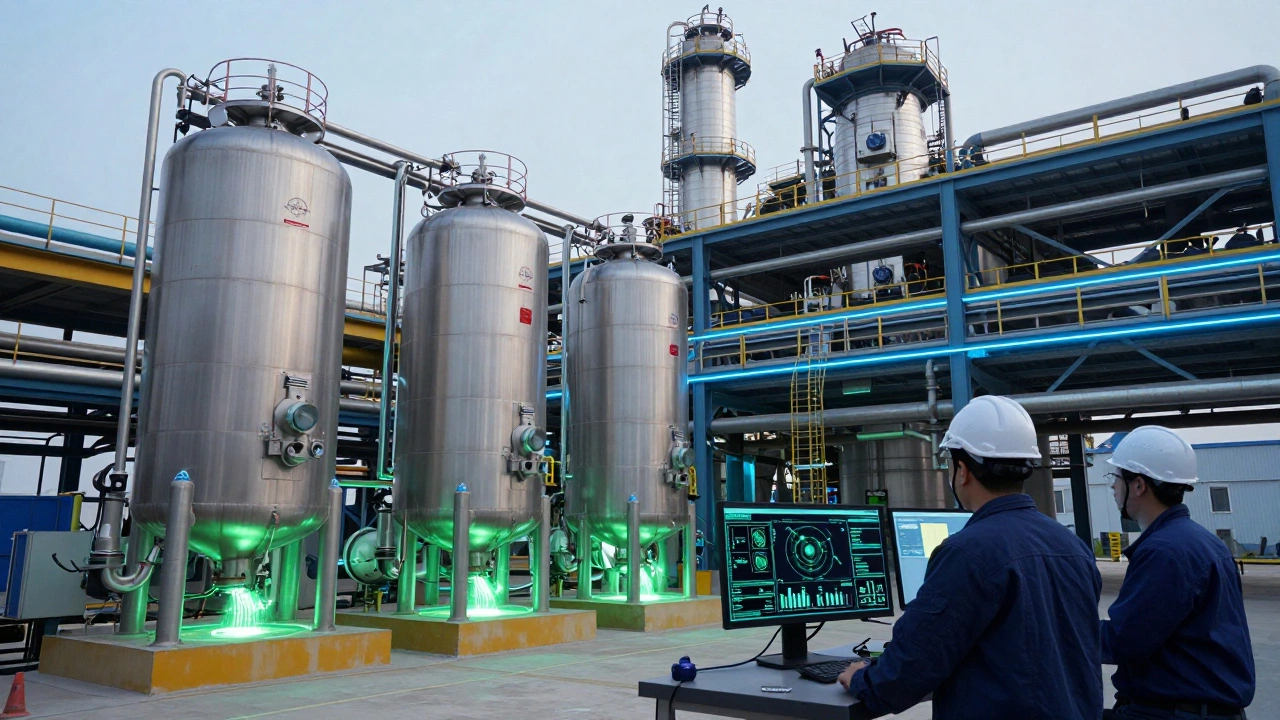
- Specialty alloys: High-nickel stainless steel for surgical tools, titanium alloys for jet engines, and ultra-pure steel for semiconductor tools. Few US mills produce these in bulk.
- Thin-gauge sheet: Used in appliances and electronics. Some Asian mills can produce thinner, more consistent sheets at lower cost.
- Hot-rolled coil: Sometimes imported for temporary shortages, but domestic mills ramp up production within weeks.
Even when imports happen, they’re often from North American partners. About 40% of US steel imports come from Canada and Mexico-countries that are part of the USMCA trade deal. That means the steel is still part of a North American supply chain.
Why it matters
Steel isn’t just metal. It’s jobs. It’s security. It’s infrastructure. When the US stopped making steel in large numbers, it lost control over its supply chain. That became painfully clear during the pandemic, when global shipping collapsed and prices spiked.
Today, every new factory, every wind turbine, every electric bus relies on steel that’s been made, tested, and shipped within 1,000 miles. That’s resilience. That’s sovereignty. And that’s why the US doesn’t just make steel anymore-it’s betting its future on it.
Does the US still have steel mills?
Yes. The US has 140 active steel mills as of 2025. Most are modern electric arc furnaces that recycle scrap steel. Major producers include Nucor, Steel Dynamics, and U.S. Steel, with facilities in Texas, Pennsylvania, Indiana, and Alabama.
Is most of the steel in the US imported from China?
No. Less than 2% of US steel imports come from China. The majority of imports come from Canada, Mexico, Brazil, and South Korea. Over 85% of steel used in the US is produced domestically.
Why did US steel mills close in the past?
Older mills closed because they relied on outdated blast furnaces, high labor costs, and inefficient processes. They couldn’t compete with modern, automated mini-mills that use scrap steel and electric arc furnaces. It wasn’t a collapse-it was a transformation.
Can the US make enough steel for infrastructure projects?
Yes. Federal law requires that steel used in federally funded infrastructure projects be made in the US. Mills have ramped up production to meet demand from wind farms, electric vehicles, and highway repairs. Domestic production has increased by 18% since 2020.
Is American steel better than imported steel?
For most applications, yes. US mills produce steel with tighter tolerances, better quality control, and higher consistency for structural uses. Imported steel often fills niche roles-like ultra-thin sheets or specialty alloys-that US mills don’t prioritize. For bridges, cars, and buildings, American steel is the standard.