Food Processing Unit Operations Quiz
Test your understanding of food processing unit operations. Each question has one correct answer. Select your answer and click 'Check Answer' to see if you're right.
Question 1: Which unit operation would be most appropriate for making flour from wheat?
Question 2: What is the primary purpose of pasteurization in food processing?
Question 3: Which unit operation is responsible for separating oil from olives during olive oil production?
Question 4: Which unit operation would be most important for making a product that needs to remain shelf-stable for several years?
Question 5: What unit operation is primarily responsible for ensuring consistent flavor distribution in powdered drink mixes?
Quiz Results
Your score: 0/5
When you think about how milk becomes yogurt, or how wheat turns into bread, it’s easy to imagine a magical transformation. But behind every food product you buy lies a series of simple, repeatable steps called unit operations. These are the building blocks of food processing - the same physical and mechanical tasks used in factories worldwide to make food safe, shelf-stable, and consistent. Whether you’re making jam in a small kitchen or producing millions of bottles of juice, these operations don’t change. They’re the foundation of everything from snacks to ready meals.
Size Reduction: Cutting, Grinding, and Milling
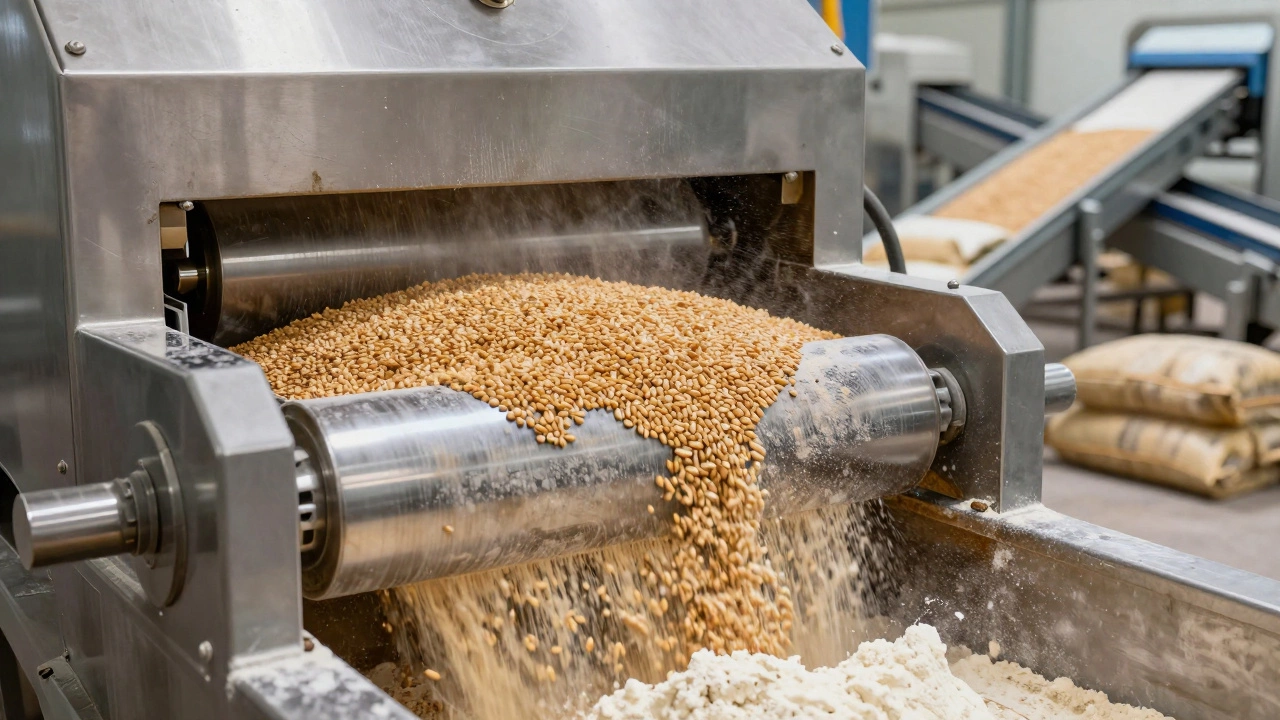
Before you can mix, heat, or package food, you often need to break it down. Size reduction is one of the most common unit operations. Think about how carrots are diced for soups, or how coffee beans are ground before brewing. In industrial settings, this is done with crushers, grinders, or roller mills. For flour production, wheat kernels are passed through a series of rollers that crack the bran, separate the germ, and grind the endosperm into fine powder. The goal isn’t just to make things smaller - it’s to increase surface area. More surface means faster heating, better mixing, and more efficient extraction of flavors or nutrients. If you’ve ever noticed how instant soup mixes dissolve so quickly, that’s because the ingredients were ground to a very fine size during processing.
Mixing and Blending: Uniformity Matters
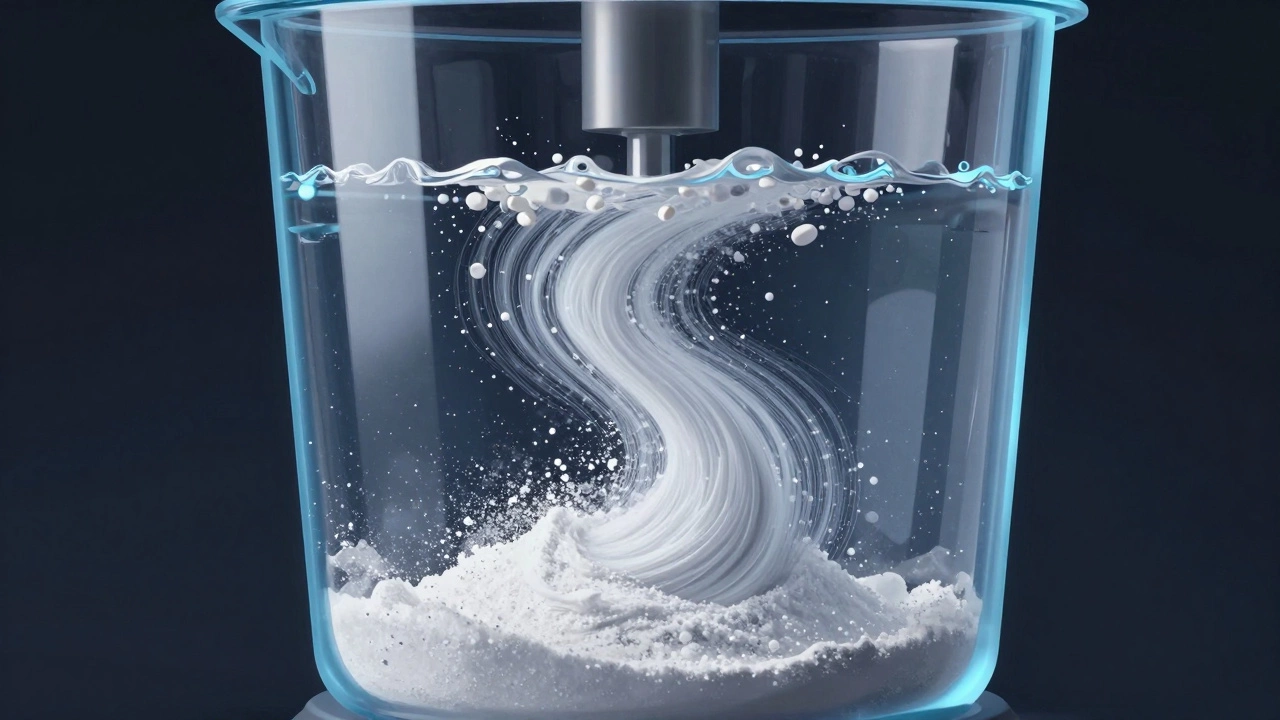
Ever wonder why every bite of your breakfast cereal tastes the same? Or why your peanut butter doesn’t separate into oil and solids? That’s thanks to mixing. In food processing, blending isn’t just stirring. It’s a precise science. Different ingredients have different densities, viscosities, and particle sizes. A mixer that works for flour and water won’t work for thick sauce and chunks of meat. Industrial mixers use rotating blades, ribbon designs, or even vacuum systems to ensure every particle ends up in the right place. In powdered drink mixes, even a 1% imbalance in sugar or flavoring can ruin a whole batch. That’s why mixing tanks are often tested with tracer dyes or sensors to confirm homogeneity before packaging.
Heat Treatment: Pasteurization, Sterilization, and Drying
Heat is one of the oldest and most powerful tools in food processing. Pasteurization - heating food to kill harmful bacteria without cooking it - is used in milk, juice, and even some ready-to-eat meals. The standard for milk is 72°C for 15 seconds. That’s enough to kill E. coli and Salmonella, but not enough to change the taste. Sterilization goes further. Canned foods like soups or beans are heated to 121°C under pressure to destroy even heat-resistant spores. This lets them sit on shelves for years. On the flip side, drying removes water to prevent spoilage. Spray drying turns liquid milk into powder. Freeze drying preserves strawberries without crushing them. Each method is chosen based on the food’s structure, sensitivity, and how long it needs to last.
Separation: Filtering, Centrifuging, and Sedimentation
Not everything in food belongs together. Separation removes unwanted parts. Think of how olive oil is pressed from olives - the oil flows out, while solids stay behind. In juice production, centrifuges spin the pulp at high speed to separate clear liquid from fiber. Filtration removes yeast from beer or proteins from whey. Sedimentation lets heavier particles sink naturally - like how sand settles out of water in a settling tank. These aren’t just cleanup steps. They’re critical for quality. Cloudy apple juice? That’s usually because the filtration system wasn’t calibrated right. Clear, bright products aren’t accidents - they’re the result of well-tuned separation.
Mass Transfer: Drying, Absorption, and Extraction
This one’s a bit more technical, but it’s everywhere. Mass transfer means moving substances from one place to another. In dehydration, water moves out of food into the surrounding air. In flavor extraction, compounds from herbs or spices dissolve into oil or alcohol. Infusing tea leaves with hot water is mass transfer too. Industrial systems use vacuum chambers, heated air tunnels, or solvent baths to speed this up. Coffee decaffeination uses supercritical CO2 to pull caffeine out without removing flavor. Soybean oil is extracted using hexane, then the solvent is removed and recycled. The key is control - too much heat, and you burn the flavor. Too little, and you don’t get enough yield.
Forming and Shaping: Molding, Extruding, and Coating
Food doesn’t just need to taste good - it needs to look good and fit in packaging. Forming turns dough into cookies, pasta into noodles, or meat into patties. Extrusion is one of the most versatile methods. Imagine pushing a mixture of corn, water, and flavor through a die under high pressure. As it exits, it puffs up into cereal shapes. This same process makes pet food, snack bars, and even plant-based meat alternatives. Coating adds layers - chocolate on ice cream, sugar on donuts, or a protective film on fruit to reduce moisture loss. These aren’t just cosmetic. Coatings can extend shelf life, improve texture, or even deliver nutrients.
Packaging: The Final Barrier
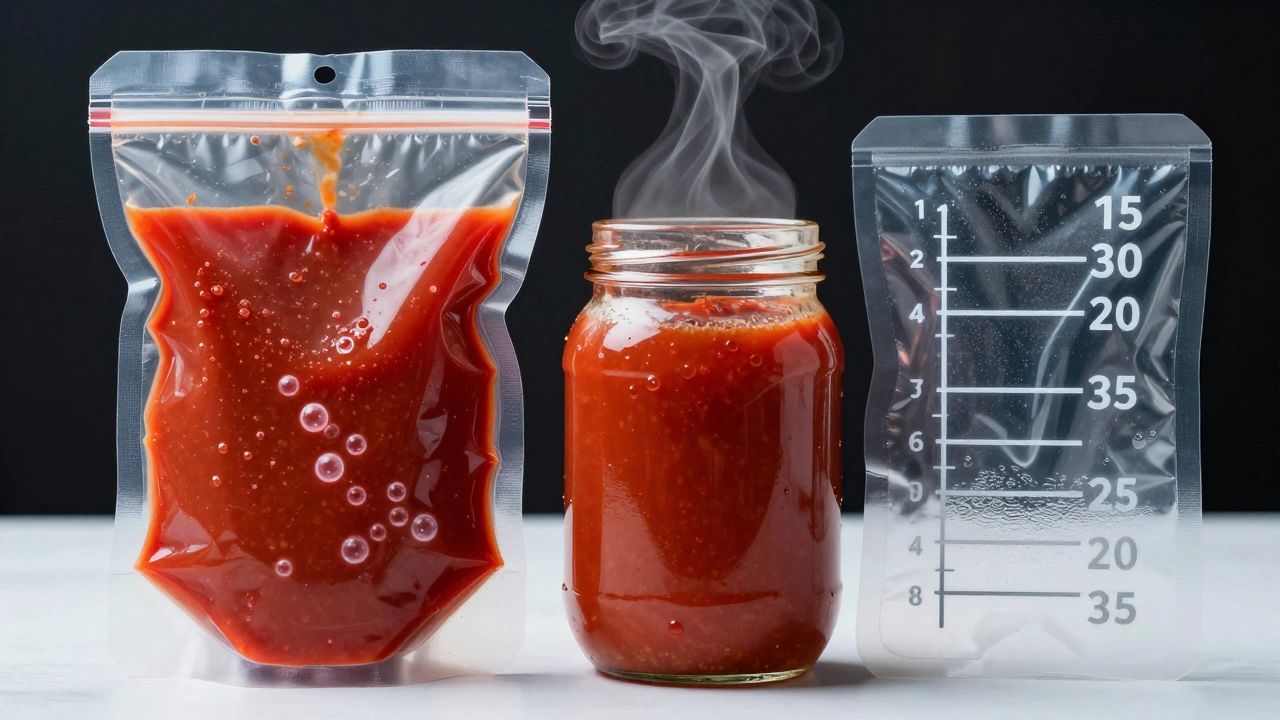
It’s easy to overlook, but packaging is a unit operation. It’s not just putting food in a box. It’s about creating a barrier - against air, moisture, light, and microbes. Vacuum sealing removes oxygen to slow spoilage. Modified atmosphere packaging (MAP) replaces air inside the package with nitrogen or carbon dioxide to keep chips crisp and salads fresh. Aseptic filling keeps sterile food in sterile containers without heat treatment after sealing. The right packaging can double a product’s shelf life. A tomato sauce in a glass jar lasts weeks. The same sauce in a vacuum-sealed pouch can last over a year.
Why These Operations Matter More Than You Think
These six or seven unit operations aren’t just technical steps. They’re the reason we have safe, affordable, and varied food year-round. Without size reduction, we couldn’t make fine powders for infant formula. Without mixing, nutritional supplements wouldn’t be evenly distributed. Without heat treatment, outbreaks from contaminated food would be far more common. These operations are standardized for a reason: they work. And they’re scalable. The same centrifuge that separates cream from milk in a small dairy can be scaled up to process thousands of liters an hour in a multinational plant.
Even small food businesses rely on these principles. A local jam maker uses size reduction (chopping fruit), heat treatment (boiling to kill mold), and packaging (glass jars sealed with lids) - just like a factory. The difference isn’t the process. It’s the scale and automation.
What Happens When Unit Operations Go Wrong?
When mixing fails, you get uneven seasoning. When heat treatment is too weak, pathogens survive. If separation isn’t thorough, you end up with gritty juice or oily sauces. One major recall in 2023 happened because a batch of frozen meals wasn’t properly pasteurized - resulting in Listeria contamination. The root cause? A sensor in the pasteurization tunnel had drifted out of calibration. That’s how precise these operations need to be. A 0.5°C error can mean the difference between safe and dangerous.
Are unit operations the same in home cooking and industrial food processing?
Yes, the core unit operations are the same. Chopping, heating, mixing, and drying are used in both kitchens and factories. The difference is in control, scale, and consistency. A home cook might chop vegetables by hand; a factory uses a high-speed slicer with laser-guided precision. A home baker might let dough rise naturally; a commercial bakery uses temperature-controlled proofing chambers. The principles are identical - it’s the tools and monitoring that change.
Can unit operations be skipped in food processing?
No - skipping any of them risks safety, quality, or shelf life. For example, if you skip pasteurization in milk, you’re inviting harmful bacteria. If you skip mixing in a powdered supplement, some servings could have too much or too little of a vitamin. Even packaging isn’t optional - without it, food spoils faster, gets contaminated, or loses flavor. Some artisanal products may appear to skip steps, but they rely on other methods - like high salt content or fermentation - to do the job of preservation instead.
Which unit operation is most important for food safety?
Heat treatment - especially pasteurization and sterilization - is the most critical for killing pathogens. But it’s not the only one. Separation removes visible contaminants, and packaging prevents recontamination after processing. A full system of unit operations works together. One failure can undo the others. That’s why food safety audits check every step, not just the final product.
Do all food products go through all unit operations?
No. Each product follows its own path. Fresh-cut fruit might only go through size reduction and packaging. Raw frozen vegetables might skip mixing and forming, but still need washing and blanching (a type of heat treatment). A chocolate bar goes through mixing, forming, coating, and packaging - but not drying or filtration. The operations used depend entirely on the raw material and the final product’s requirements.
How do unit operations affect nutrition?
They can both preserve and reduce nutrients. Heat can destroy vitamin C, but it also kills enzymes that break down other nutrients. Drying removes water, which concentrates sugars and calories. Freezing preserves most nutrients better than canning. Mixing ensures even distribution of added vitamins. The goal isn’t to preserve everything - it’s to deliver a safe, stable product with acceptable nutrition. Modern processing often adds back nutrients lost during heating, like in fortified cereals or plant-based milks.
What Comes Next?
Understanding unit operations doesn’t just help you appreciate your food - it opens up possibilities. Whether you’re starting a small food business, studying food science, or just curious about how your lunch is made, knowing these steps gives you real insight. You’ll see why some products cost more (they use more complex operations), why others last longer (better packaging), and why some taste inconsistent (poor mixing). It’s not magic. It’s mechanics - and it’s everywhere.