Tech Hub Career & Investment Decision Tool
Define Your Priorities
Adjust the sliders to reflect what matters most to you or your business.
Software/SaaS
Semiconductors/Hardware
Venture Capital
Govt Incentives (PLI)
Networking/Chaos
Infrastructure/Calm
Intangible (Code/Data)
Tangible (Products/Chips)
Budget Not an Issue
Value for Money
Comparison Analysis
Bangalore
Hyderabad
Bangalore is the Best Fit
Based on your priorities, the legacy ecosystem and software density of Bangalore offer the highest potential for success.
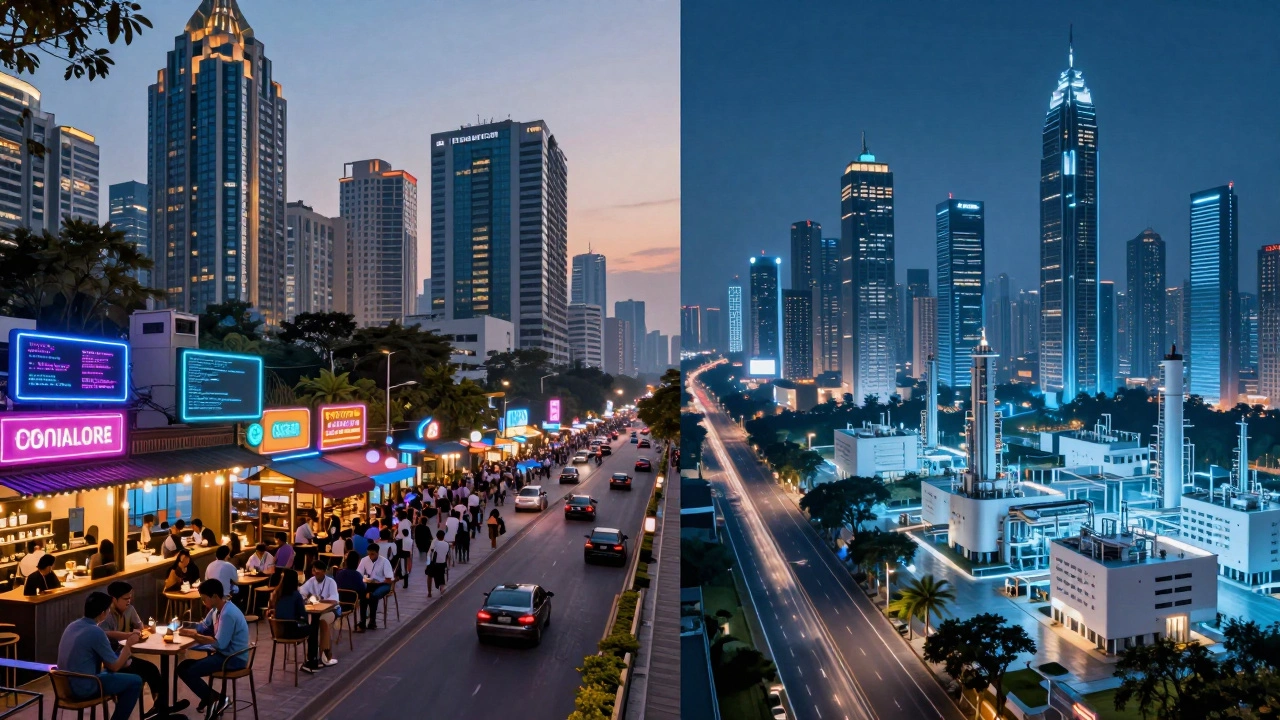
Walk down MG Road in Bangalore is the historic capital of Indian technology and innovation, and you’ll hear a mix of Kannada, English, and code snippets being discussed over coffee. Cross the country to Hitec City in Hyderabad is a rapidly growing technology center known for its planned infrastructure and semiconductor focus, and the vibe shifts from chaotic startup energy to structured corporate efficiency. If you are asking which city holds the crown as India’s number one technology hub in 2026, the answer isn’t just about who has more offices. It depends on whether you value legacy networks or future-proof manufacturing.
The Legacy Powerhouse: Why Bangalore Still Leads in Software
Bangalore didn’t become the "Silicon Valley of India" by accident. Since the 1980s, when government research labs like ISRO and BEL set up shop here, the city built a dense network of talent. Today, that network is worth billions. The city hosts headquarters for giants like Flipkart, Swiggy, and Byju’s (before its fall), alongside global R&D centers for Microsoft, Google, and Amazon.
The real strength of Bangalore lies in its ecosystem depth. You can find a senior Python developer, a UI/UX designer, and a venture capitalist within a five-mile radius. This density creates a feedback loop: startups hire locally, scale quickly, and then mentor the next wave of founders. For software services, SaaS products, and AI research, Bangalore remains unmatched. The sheer volume of job postings and funding rounds still outpaces any other Indian city.
However, this success has come at a cost. Infrastructure strain is real. Traffic congestion adds hours to daily commutes, pushing some companies to look elsewhere for operational stability. Yet, despite these challenges, the brand value of being based in Bangalore continues to attract top-tier global investment.
The Rising Challenger: Hyderabad’s Strategic Shift to Hardware
If Bangalore is the heart of Indian software, Hyderabad is becoming the brain of Indian hardware. Over the last five years, Hyderabad has transformed from a secondary IT destination into a primary hub for electronics manufacturing and semiconductors. This shift wasn’t accidental; it was driven by aggressive state policies and land availability that Bangalore simply couldn’t match.
In 2024 and 2025, major announcements solidified this position. Texas Instruments broke ground on a $3 billion semiconductor fab, followed closely by Micron Technology with a $12 billion memory chip facility. These aren’t just assembly plants; they are high-tech fabrication units that require precision engineering and advanced supply chains. For anyone interested in electronics manufacturing India, Hyderabad is now the focal point.
The city’s advantage is space and planning. Unlike Bangalore’s organic, often unplanned growth, Hyderabad’s IT corridors were designed with wide roads and dedicated industrial zones. This makes logistics smoother for heavy machinery and raw materials needed in hardware production. Companies looking to move beyond service exports into physical product creation find Hyderabad’s environment far more conducive.

Manufacturing Momentum: How Policy Shapes the Landscape
To understand why Hyderabad is gaining ground, you have to look at the Production Linked Incentive (PLI) scheme is an Indian government initiative offering financial incentives to boost domestic manufacturing. Launched nationally but implemented aggressively in Telangana, this policy offers subsidies for setting up electronics assembly and semiconductor units. The result? A surge in foreign direct investment (FDI) flowing into Hyderabad rather than traditional hubs.
Consider the numbers. In 2025 alone, over $10 billion in committed investments went toward semiconductor and display manufacturing in the region. Compare that to Bangalore, where most new investments are still in software development and digital services. The PLI scheme effectively tilted the playing field, making hardware manufacturing financially viable in India for the first time at scale.
This doesn’t mean Bangalore is losing relevance. Instead, the two cities are diverging in specialization. Bangalore dominates intangible assets-code, data, algorithms. Hyderabad is capturing tangible assets-chips, phones, circuit boards. For investors and engineers alike, understanding this split is crucial for career and business decisions in 2026.
| Feature | Bangalore | Hyderabad |
|---|---|---|
| Primary Focus | Software, SaaS, Startups | Semiconductors, Electronics Mfg |
| Key Advantage | Talent Density & Ecosystem | Infrastructure & Land Availability |
| Major Players | Flipkart, Infosys, Microsoft | Texas Instruments, Micron, TCS |
| Growth Driver | Venture Capital & Innovation | Government PLI Scheme |
| Cost of Living | High (Premium Real Estate) | Moderate (Better Value) |
Beyond the Big Two: Pune, Chennai, and NCR
While the battle for the top spot usually happens between Bangalore and Hyderabad, other cities are carving out niches. Pune is a key technology and automotive engineering hub in western India has emerged as a strong contender for embedded systems and IoT devices. Its proximity to Mumbai provides access to capital, while its academic institutions like COEP and MIT provide steady talent flow.
Chennai is India's leading automobile and electronics manufacturing cluster in the south remains the undisputed king of consumer electronics assembly. With Samsung’s massive mobile phone factory and Foxconn’s operations, Chennai handles a significant portion of India’s smartphone exports. If your definition of "tech hub" includes mass manufacturing of finished goods, Chennai deserves serious consideration.
New Delhi and Gurugram (NCR) dominate in fintech and enterprise software. However, they lack the physical infrastructure for large-scale electronics manufacturing due to land scarcity and environmental regulations. Their strength lies in policy-making and corporate headquarters rather than production floors.

What Does This Mean for Jobs and Business?
If you are an engineer specializing in VLSI design or supply chain management for hardware, Hyderabad is likely your best bet. The demand for skilled workers in semiconductor fabs is outstripping supply, leading to competitive salaries and rapid career progression. Conversely, if you are a full-stack developer, data scientist, or entrepreneur building a platform-based business, Bangalore’s network effects will accelerate your growth faster than anywhere else.
For businesses, the choice depends on your product type. Service-oriented companies benefit from Bangalore’s deep talent pool and established client relationships. Product-based companies, especially those involving physical goods, should evaluate Hyderabad or Chennai for their manufacturing capabilities and logistical advantages. The era of one-size-fits-all tech hubs is over; specialization is the new norm.
The Verdict: Who Wins in 2026?
There is no single winner because "technology" has bifurcated. If we measure by revenue generated from software services and startup valuations, Bangalore remains the undisputed number one. Its ecosystem is mature, diverse, and globally connected. However, if we measure by strategic importance to national security and future economic resilience through electronics manufacturing India, Hyderabad is taking the lead. The government’s push for self-reliance in chips and hardware gives Hyderabad a momentum that Bangalore cannot easily replicate due to spatial constraints.
So, which city is no. 1? It depends on what you value. For pure software innovation, stick with Bangalore. For the future of hardware and manufacturing, watch Hyderabad. The smartest players in 2026 are doing both-using Bangalore for brains and Hyderabad for brawn.
Is Bangalore still the best place for tech jobs in India?
Yes, for software development, AI, and startup roles, Bangalore remains the top choice due to its high concentration of companies and talent. However, for hardware and semiconductor jobs, Hyderabad is now offering better opportunities and faster growth.
Why is Hyderabad growing faster than Bangalore in recent years?
Hyderabad’s growth is driven by government incentives like the PLI scheme, abundant land for large factories, and better infrastructure planning. While Bangalore struggles with traffic and space, Hyderabad has attracted massive investments in semiconductor and electronics manufacturing.
Which city is better for electronics manufacturing startups?
Hyderabad is currently the best hub for electronics manufacturing startups due to access to semiconductor fabs, testing facilities, and supply chain networks. Chennai is also a strong option for final assembly and export-focused operations.
How does the PLI scheme affect tech hubs?
The Production Linked Incentive (PLI) scheme provides financial rewards for domestic manufacturing. This has shifted investment towards cities with industrial capacity like Hyderabad and Chennai, boosting their status as tech hubs beyond just software services.
Can Pune compete with Bangalore and Hyderabad?
Pune is a strong competitor, particularly in embedded systems, IoT, and automotive tech. While it may not surpass Bangalore in pure software volume, it offers a balanced lifestyle and growing infrastructure, making it a viable alternative for specialized tech roles.